A leather guitar strap is the best first strap project there is: one long piece of firm 6–8 oz veg-tan, two slotted end tabs for the strap buttons,…
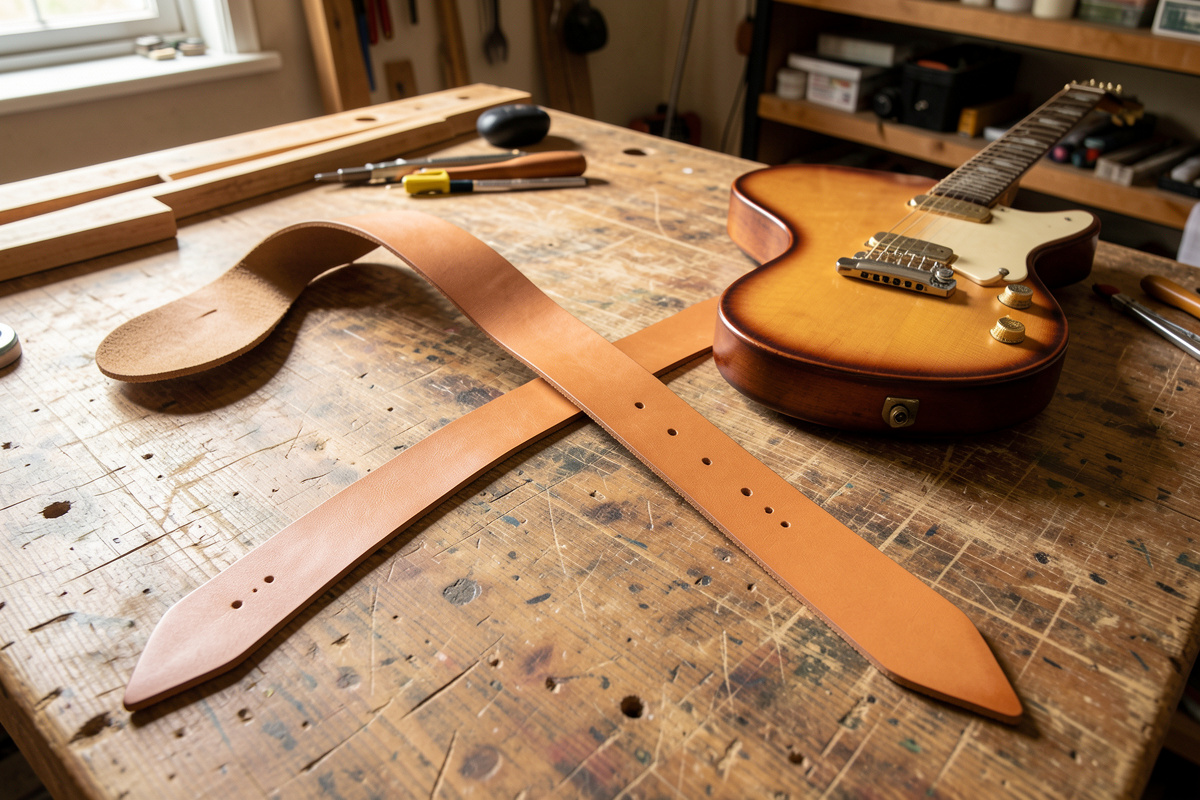
A leather guitar strap is the best first strap project there is: one long piece of firm 6–8 oz veg-tan, two slotted end tabs for the strap buttons, tapered ends, and a wide shoulder section. It teaches straight cutting, symmetric edge finishing, and clean slot-cutting with no adjusters, padding, or complex hardware to fail. Cut it right and it will hold a heavy solid-body for decades — the leather outlasts the guitar.
I have made several, and the one lesson that shaped all of them came from ruining an end tab on the first. I cut the button slot too close to the end and too short, hung a heavy Les Paul-style body on it, and within a few sessions the slot had torn out to the edge and the guitar nearly hit the floor. Nothing about that was bad luck — the slot was in the wrong place and unreinforced. Everything below is built around not repeating it.
This is one build in the wider strap-making projects guide. If you have not chosen a hide yet, start with the strap leather guide — a guitar strap lives or dies on firm, low-stretch leather.
How Long Should a Leather Guitar Strap Be?
A standard guitar strap adjusts roughly between 40 and 60 inches end to end, which suits most players from a high classical position to a low rock stance. For a fixed-length strap, measure from one strap button, over your shoulder, to the other button while wearing the guitar at your preferred height, and add a few inches for the end tabs. Most players land around 48–52 inches total.
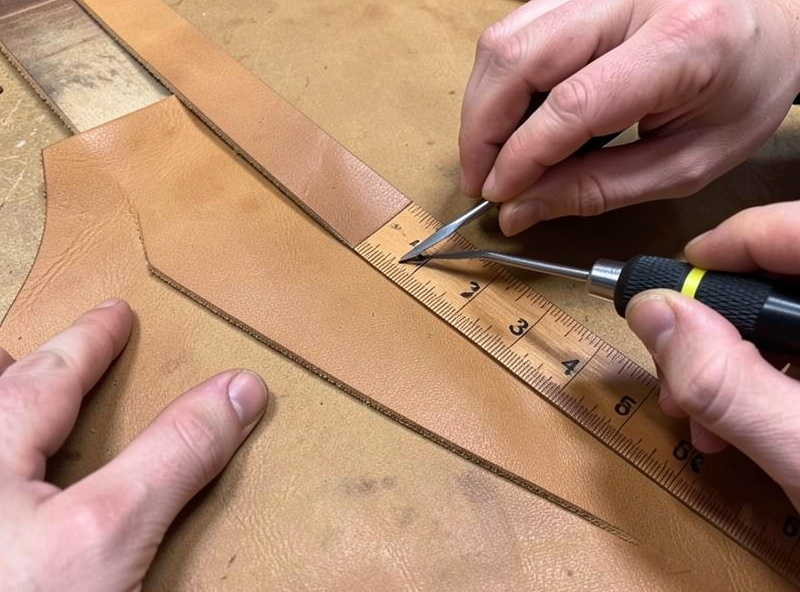
The honest answer is that strap length is personal and posture-driven, so I build in adjustment unless someone tells me their exact playing height. A simple leather guitar strap gets its adjustment from a series of holes near one end and a slot-and-tab or buckle that lets you change the effective length — the same fold-and-slot logic used everywhere in strap work. If you want a truly fixed strap dialed to one player, have them stand and hold the guitar exactly where they play, run a tape from button to button over the shoulder, and that measurement plus tab allowance is your cut length. I keep the shoulder section — the part that actually rests on you — at least 2 inches wide so it never digs in, tapering down to about 1 inch at the ends where it meets the buttons.
What Leather and Weight Work Best for a Guitar Strap?
Firm veg-tan or bridle leather at 6–8 oz is ideal: heavy enough to resist stretch under a solid-body guitar, thin enough to stay flexible over the shoulder and fold cleanly at the end tabs. Lighter than 6 oz and the strap stretches and the slots tear; heavier than 8 oz and it is stiff and awkward at the tabs. This is the sweet spot for the whole project.
I reach for a firm veg-tan shoulder or a bridle bend in this weight because it does two jobs a guitar strap demands at once — it carries a heavy instrument without elongating, and it takes tooling or a burnished edge beautifully. For this project I usually pull from a Wickett & Craig veg-tan shoulder, because their published weight and temper specs take the guesswork out of hitting exactly 6–8 oz (Wickett & Craig). A solid-body electric is a real load hanging from two small buttons for hours, so stretch is the enemy; the firmness that resists it is exactly the firmness that holds a clean slot. Chrome-tan is wrong here for the same reason it is wrong on any load-bearing strap: it stretches and its slots elongate. If the player wants extra comfort, the answer is width or a padded build, not softer leather.
How Do You Cut and Reinforce the End Tabs and Button Slots?
Cut the button slot as a keyhole — a round hole punched first, then a short slit toward the end — kept well back from the tip and no wider than the button shaft. Reinforce the tab by doubling the leather or leaving it full-thickness while thinning the shoulder, and burnish the slot edges. A slot cut too close to the end or too wide is the number one guitar strap failure.
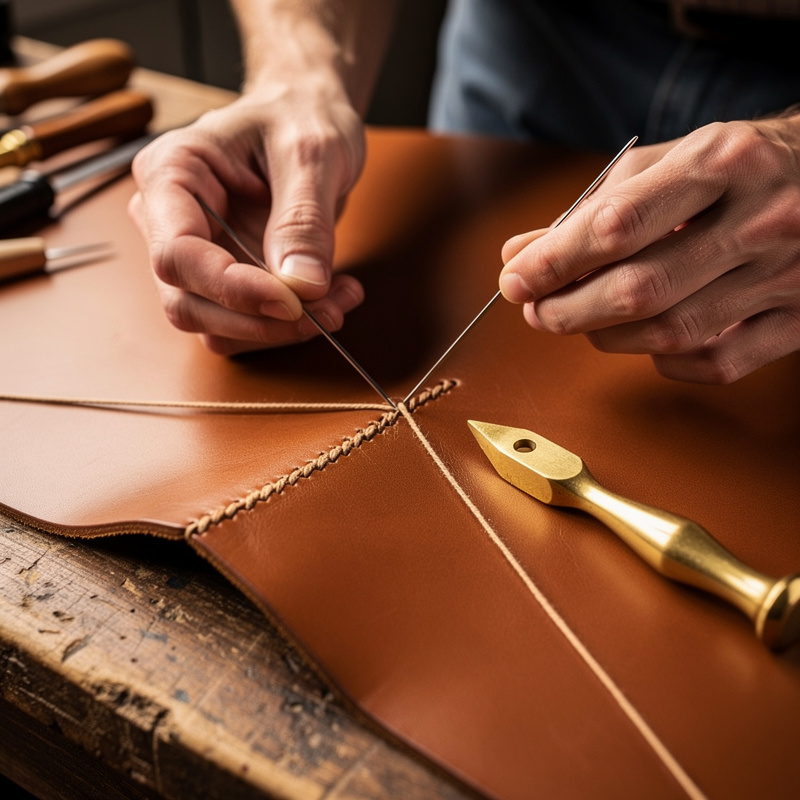
This is the part I get most careful about, because it is exactly where I failed the first time. I punch a clean round hole with a punch sized to the button neck, then cut a short straight slit from that hole toward the end of the tab — the round hole stops the slit from tearing further, which a plain straight slot will not do. I keep the closed end of the keyhole a solid margin back from the tip so there is real leather between the slot and the edge, and I never widen the slot to the button head, only the shaft. On a heavy guitar I leave the end tabs at full thickness (skiving only the shoulder for flex) or double them for extra grip around the button. Then I bevel and burnish the slot edges so nothing frays. The sensory check: push a strap button through and it should snap in with a firm resistance and sit without the slot gaping — if it slides in loose, the slot is too wide and will let go. For heavy instruments, dedicated strap-locks like Schaller’s are worth fitting, and their sizing guidance is worth a look before you punch (Schaller).
How Do You Finish the Edges of a Guitar Strap?
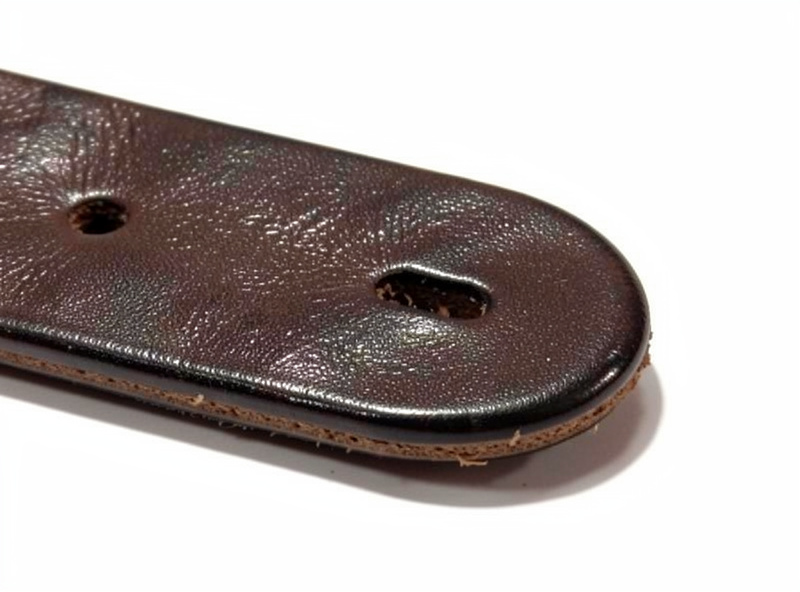
Bevel both long edges, sand from around 400 up to 800 grit, case the edge with Tokonole, and burnish hard with a slicker until the fibers lay down glassy, then wax. A guitar strap is almost all edge by visible surface, so a clean burnished edge is the single thing that makes it read as made rather than cut. Skip it and the strap looks homemade no matter how good the leather.
Because the strap is long and both edges are on full display over the shoulder, I treat edge finishing as the main event, not a final chore. I run a #2 beveler down both grain-side corners, sand up through the grits, then burnish with one of the PETG edge slickers I printed for this exact leather weight — the grooved profile matches a 6–8 oz edge so the friction lays the fibers down fast. You can hear the edge go from a dry drag to a slick hum under the tool as it polishes. On veg-tan I case first with a little water and Tokonole; on bridle I often go straight to wax because the leather is already stuffed. The finished edge should feel rounded and hard, like it was molded rather than cut.
Can You Personalize a Guitar Strap With Tooling or Engraving?
Yes — veg-tan is the leather that tools, stamps, and engraves, so a guitar strap is a natural canvas for a name, a pattern, or a maker’s mark. Tool it while the leather is cased and damp before you assemble, or laser-engrave a veg-tan panel for crisp lettering. Do all decoration before edge-finishing and dyeing so nothing smears.
A guitar strap is the piece people most want personalized, and veg-tan is made for it. With hand tools I case the leather and use a swivel knife and stamps to cut a pattern or border. When someone wants crisp, repeatable lettering or a detailed graphic, I engrave the veg-tan with the workshop laser instead — the same laser that cuts my clean strap templates engraves the panel, which is a crossover a pure leather shop cannot match (I cover the settings in the laser-engraved leather panel work). Either way, decoration comes first in the sequence: tool or engrave, then dye, then edge-finish and assemble. Do it out of order and you burnish over a smeared design.
How Do You Assemble the Finished Strap?
Cut the blank, taper the ends, cut and reinforce the button slots, tool or engrave any decoration, dye and seal, finish the edges, then punch the adjustment holes and add any buckle or strap-lock hardware. Assembly is mostly ordering: every messy step happens before the edges are burnished, and hardware goes on last. Rushing the sequence is what smears finishes and misplaces slots.
My order is fixed because I have paid for getting it wrong: measure and cut the blank straight from the firm bend, mark and taper the ends symmetrically, cut the keyhole slots with proper edge distance, do all tooling or engraving while the leather is cased, dye and let it dry, condition lightly, seal, then bevel-sand-slick-wax the edges, and only then punch adjustment holes and fit hardware. If the strap uses a buckle for adjustment rather than a slotted tab, anchor it with a stitched fold exactly as in the hardware guide so it never pulls through. Basic strap buttons or upgraded guitar strap locks finish the job.
As an Amazon Associate I earn from qualifying purchases.
What I Would Do for Your First Guitar Strap
Buy a firm 7 oz veg-tan or bridle blank, keep the shoulder 2.5 inches wide and the tabs 1 inch, and put your whole attention into two things: cutting the keyhole slots with real edge distance, and finishing the edges properly. Everything else is forgiving. A guitar strap rewards patience because it is simple enough to get completely right — and when a player hangs a heavy instrument on a strap you cut and burnished by hand, and the slots hold and the edge is glassy, you will understand exactly why the edge is the whole craft.
Related Guides
- Leather Strap Making Projects: The Complete Guide
- Best Leather for Straps: Why Bridle and Harness Beat Soft Hides
- How to Attach Strap Hardware Without Rivets Pulling Through
- How to Make a Leather Camera Strap: Comfort, Width, and Lug Hardware
What leather is best for a guitar strap?
Firm veg-tan or bridle leather at 6 to 8 oz. It is heavy enough to resist stretch under a solid-body guitar but thin enough to stay flexible over the shoulder and fold cleanly at the end tabs. Avoid soft chrome-tan, which stretches and lets the button slots elongate and tear.
How long should a leather guitar strap be?
A standard adjustable strap ranges roughly 40 to 60 inches end to end. For a fixed strap, wear the guitar at your preferred height and measure from button to button over your shoulder, then add a few inches for the end tabs. Most players land around 48 to 52 inches total.
How do you keep a guitar strap button slot from tearing?
Cut it as a keyhole: punch a round hole first, then a short slit toward the end, so the round hole stops the slit from tearing further. Keep the slot well back from the tip, no wider than the button shaft, and reinforce the tab by doubling or leaving it full thickness. Burnish the slot edges.
How wide should a guitar strap be?
Keep the shoulder section at least 2 to 2.5 inches wide so it spreads the weight and does not dig in, tapering down to about 1 inch at the ends where it meets the strap buttons. Wider shoulders carry heavy instruments more comfortably; narrow ends fit the button slots cleanly.
Can you tool or engrave a leather guitar strap?
Yes, because veg-tan is the leather that tools, stamps, and engraves well. Hand-tool it with a swivel knife while the leather is cased and damp, or laser-engrave a veg-tan panel for crisp lettering. Do all decoration before dyeing and edge-finishing so nothing smears under the burnisher.