The best leather weight for a valet tray is 5–6 oz veg-tan (2.0–2.4 mm) for shallow walls under 1.5 inches, stepping up to 7–8 oz (2.8–3.2 mm) for…
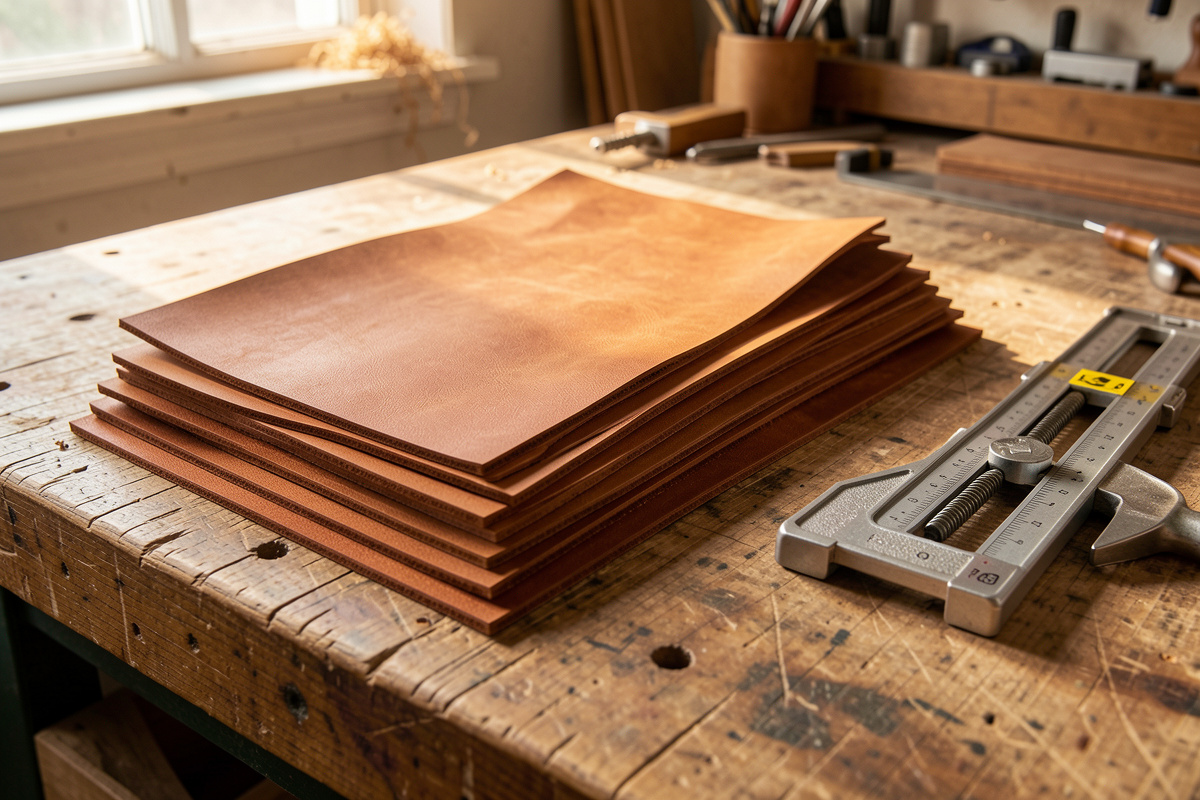
The best leather weight for a valet tray is 5–6 oz veg-tan (2.0–2.4 mm) for shallow walls under 1.5 inches, stepping up to 7–8 oz (2.8–3.2 mm) for deeper or larger trays. Below 4 oz the walls slump; above 9 oz the folded corners crack. Everything else is a variation on that band.
Weight is the one spec that decides whether your tray holds a form or turns into a soft, sad taco on the nightstand. I have built the same tray in five different weights just to feel the difference, and the failures are as instructive as the successes — a 3 oz tray that could not stand its own walls, an 8 oz one whose corner cracked white the moment I folded it. Choose wrong and no amount of careful stitching or slick edges will save the piece.
Here is the thing beginners miss: weight is not “sturdier is better.” A tray wall has to do two contradictory things — stand up stiff and fold sharp at the base — and those pull in opposite directions. This is the article where I sort out exactly where the sweet spot sits and why.
How Is Leather Weight Actually Measured?
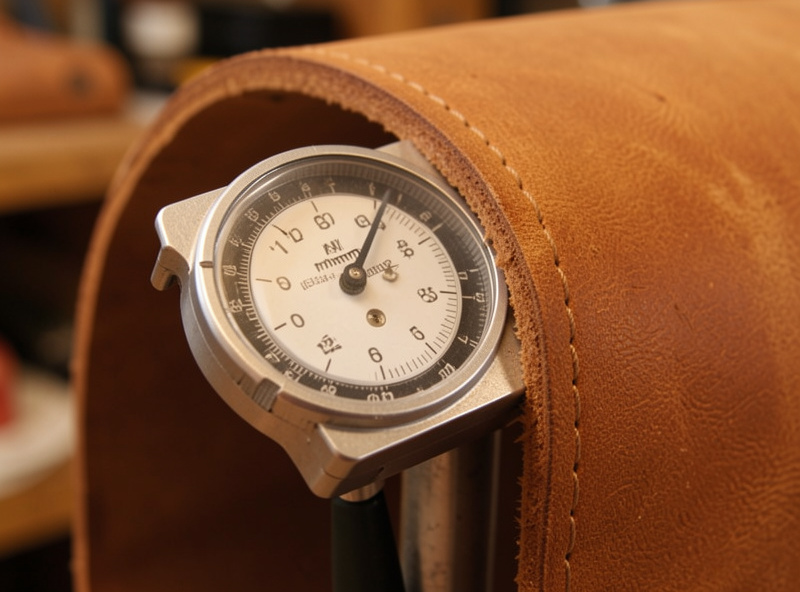
In the US, leather weight is measured in ounces, where one ounce equals about 1/64 inch of thickness — so 6 oz leather is roughly 6/64 inch, or 2.4 mm. It is a thickness measure, not a mass measure, which confuses nearly everyone at first. A “6 oz shoulder” tells you how thick the leather is, full stop.
The conversion is worth memorizing because every supplier and every pattern speaks in it, and they are not always consistent. Leather is often sold in a weight range — “5 to 6 oz” — because a natural hide varies across its area, thicker at the back and thinner at the belly. That variance is exactly why I run consistent tanneries: a Wickett & Craig or Hermann Oak shoulder holds its stated weight far more evenly than cheap import veg-tan, which can wander a full ounce within one piece and wreck your casing consistency. When I need a number I trust, I put a Tandy Leather Factory dial thickness gauge on the actual spot I am cutting rather than trusting the label. For a fuller tour of tannage, grade and weight together, my types of leather guide is the backgrounder.
One more practical note: 1 oz is about 0.4 mm. So the common tray weights convert as — 4 oz ≈ 1.6 mm, 5 oz ≈ 2.0 mm, 6 oz ≈ 2.4 mm, 7 oz ≈ 2.8 mm, 8 oz ≈ 3.2 mm. Keep that little table in your head and supplier listings stop being cryptic.
What Weight Holds a Tray Without Collapsing?
For most valet and catchall trays, 5–6 oz veg-tan is the sweet spot: stiff enough to hold a 1.5-inch wall, thin enough to fold a clean corner. Deeper trays with 2-inch-plus walls need 7–8 oz for the extra spine. This band is the answer for probably 80% of the trays you will ever build.
Here is how the weights sort out by project, measured against trays I have actually built and used:
| Tray type | Weight | Thickness | Max wall height | Behavior |
| Coin / small catchall | 5 oz | 2.0 mm | 1.25 in | Crisp folds, holds shallow walls |
| Standard valet / catchall | 6 oz | 2.4 mm | 1.75 in | Best all-round stiffness-to-fold balance |
| Deep desk / EDC tray | 7–8 oz | 2.8–3.2 mm | 2.5 in | Tall walls stay standing |
| Dice tray (rolled rim) | 4–5 oz | 1.6–2.0 mm | rolled edge | Rim stiffens it; thin folds softly |
| Wrapped pot cover / basket | 3–5 oz | 1.2–2.0 mm | tall | Rigid core carries the load |
Two rows break the “thicker wall wants thicker leather” rule, and they are the interesting ones. A dice tray uses thinner 4–5 oz leather because its rolled, padded rim does the stiffening, not the panel — I explain that in the dice tray pattern. And a wrapped pot cover can use thin 3 oz because it hugs a rigid pot and never has to stand alone. Once a rigid element enters the design, the leather weight requirement drops. That is the mental model to carry: weight only has to fight gravity when the leather itself is the structure.
Why Does Thin Leather Collapse and Thick Leather Crack?
A tray wall is a cantilever supported only at the fold, so gravity constantly pulls the top edge back down. Thin leather lacks the stiffness to resist that bending moment and slumps. Thick leather resists it fine but has too much material on the outside of a tight fold, so the grain stretches past its limit and cracks white.
The collapse is easy to picture — hold a sheet of paper by one edge and it flops; a thin card stands a little; a thick card stands well. Leather behaves the same, and the wall height is the lever arm making it worse. That is why a 4 oz tray might hold a one-inch wall but slump at two inches: same leather, longer cantilever, more leverage for gravity.
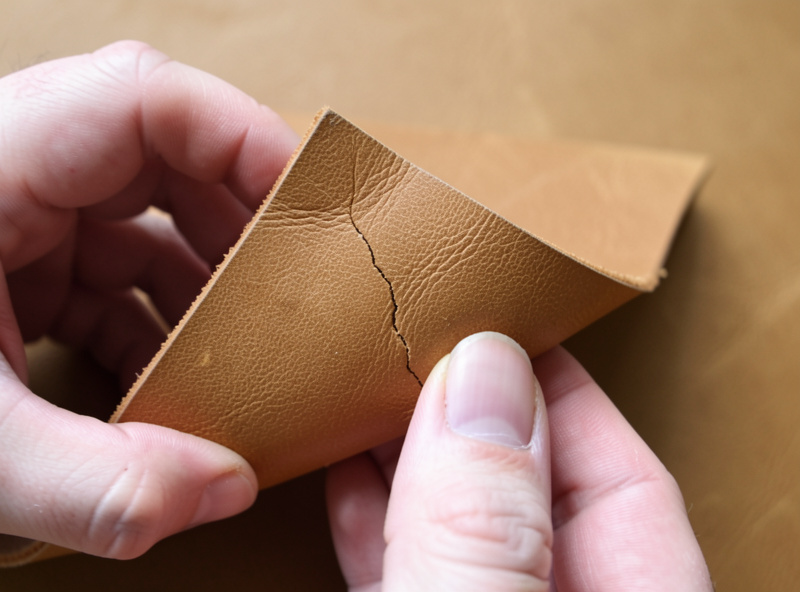
The cracking is the opposite failure and it caught me out early. When leather folds, the grain side (outside of the bend) stretches while the flesh side compresses. The thicker the leather, the farther the grain surface sits from the neutral axis of the bend, so it stretches more for the same fold radius — and past a point the grain fibers simply split, leaving a pale crack line. You can feel it coming a half-second before it happens: a faint stiffness in the fold under your thumb, then a small give, almost a whisper, as the grain lets go. On an 8 oz tray folded sharp I got exactly that: a fine white fracture along every corner. The fixes are to fold thick leather on a larger radius, skive the fold thinner, or case it first so the fibers move rather than tear. Casing is the real answer for anything above 6 oz — my wet-forming technique guide covers casing to the right dampness, and it is the difference between a fold that sets and one that splits.
Does the Tray Style Change the Weight You Need?
Yes — heavily. A snap-folded catchall needs stiff self-supporting leather (5–6 oz). A fully wet-molded tray can go slightly thinner because the set shape helps hold the wall. And any wrapped design over a rigid core drops to 3–4 oz because the leather is decoration, not structure.
The snap catchall is the most demanding on weight because nothing but the leather holds the wall between the four corner snaps — go too thin and the mid-wall bows outward. I stick to a firm 6 oz for those, and the full build is in how to make a leather catchall tray. A molded tray has an advantage: because the leather has been cased and dried into shape, the wall carries some of its own set, so you can sometimes drop half a weight and still stand tall. And wrapped work — a pot cover, a basket sleeve — inverts the whole question, which is why those can use soft chrome-tan.
The same logic shows up outside trays, incidentally. Choosing 8–10 oz bridle for a dog collar follows the identical reasoning — stiffness where the object must hold a load — and I worked through it in best leather weight for a dog collar. Weight selection is really one skill applied across every project. This whole tray family sits under my valet tray making guide if you want the overview.
How Does Wall Height Change the Weight?
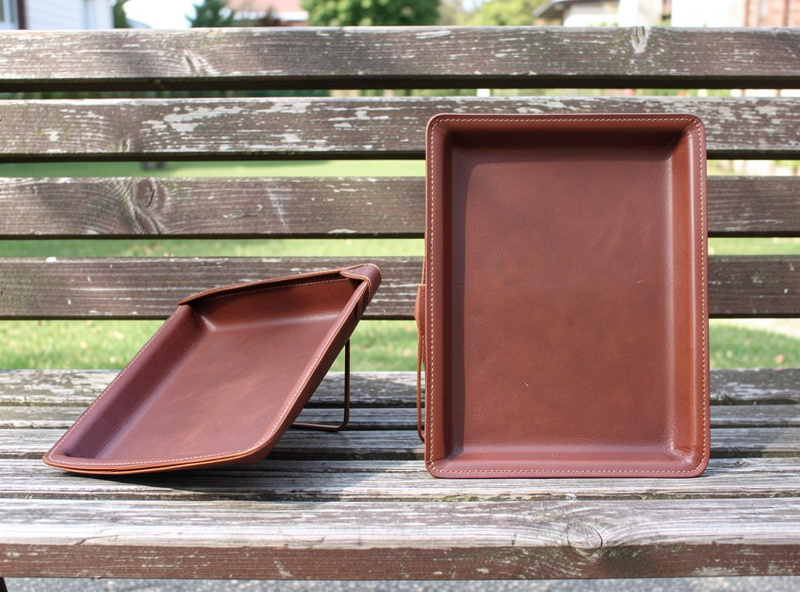
Wall height and leather weight have to agree. As a rough rule: 5 oz handles walls up to about 1.25 inches, 6 oz up to 1.75 inches, and 7–8 oz up to 2.5 inches. Taller walls need thicker leather or a molded shape, or they lean. Decide your wall height first, then pick the weight to match it.
I learned to design in that order — height first, weight second — after building a tray I wanted deep in leather that was too thin for it. The two-inch walls in 5 oz looked fine on day one and were leaning inward by the end of the week, because the cantilever finally won. Rebuilt in 7 oz, the same tray stood dead square. If you find yourself wanting tall walls in thin leather, the honest fix is not to push the weight but to change the method: wet-mold it so the shape helps hold the wall, or add a stiffened rolled rim.
One caveat on veg-tan versus chrome-tan here: these weight rules assume veg-tan, because veg-tan is far stiffer at the same thickness. A 6 oz chrome-tan would flop where 6 oz veg-tan stands, which is why chrome-tan only makes sense on wrapped designs. If that distinction is fuzzy, my chrome tan versus veg tan comparison spells out why the same thickness behaves so differently.
What I’d Buy Starting Today
If I could only stock one weight for tray work, it would be a 6 oz veg-tan shoulder — it builds the widest range of trays, from a shallow catchall to a standard valet, and folds cleanly when cased. Add a 7–8 oz piece only when you know you want deep walls. A 6–7 oz veg-tan shoulder is the most versatile single buy for this whole tray cluster.
As an Amazon Associate I earn from qualifying purchases.
And spend on temper consistency over price. The reason I name specific tanneries is not brand loyalty — it is that a consistent temper lets you case to a repeatable dampness, and repeatable casing is what makes tray corners come out the same every time. You can read the weight and temper specs straight from Wickett & Craig or Hermann Oak. Pick 6 oz, case it right, and the tray holds its form for years.
What is the best leather weight for a valet tray?
5 to 6 oz veg-tan, about 2.0 to 2.4 mm, for walls under 1.5 inches. Step up to 7 to 8 oz for deeper trays with taller walls. Below 4 oz the walls collapse and above 9 oz the folded corners crack. This band covers most trays you will build.
How is leather weight converted to millimeters?
One ounce equals about 1/64 inch, or roughly 0.4 mm. So 5 oz is about 2.0 mm, 6 oz about 2.4 mm, 7 oz about 2.8 mm, and 8 oz about 3.2 mm. Leather weight is a thickness measure, not a mass measure.
Why do thick leather tray corners crack?
When leather folds, the grain side stretches. The thicker the leather, the more the grain surface must stretch for the same fold radius, and past its limit the fibers split into a white crack line. Case the leather first or fold on a larger radius to prevent it.
Can I use chrome-tan leather for a tray?
Only for a wrapped design over a rigid core, like a pot cover. Chrome-tan is far softer than veg-tan at the same thickness and will not hold a self-supporting wall. For any tray where the leather is the structure, use veg-tan.
How tall can leather tray walls be?
Roughly, 5 oz holds walls up to 1.25 inches, 6 oz up to 1.75 inches, and 7 to 8 oz up to 2.5 inches. For taller walls, wet-mold the tray so the set shape helps hold the wall, or add a stiffened rolled rim.
Further Reading
- Leather Valet Tray Making Guide
- How to Make a Leather Catchall Tray
- Types of Leather: Tannage, Grade, and Weight
- Chrome Tan vs Veg Tan Leather