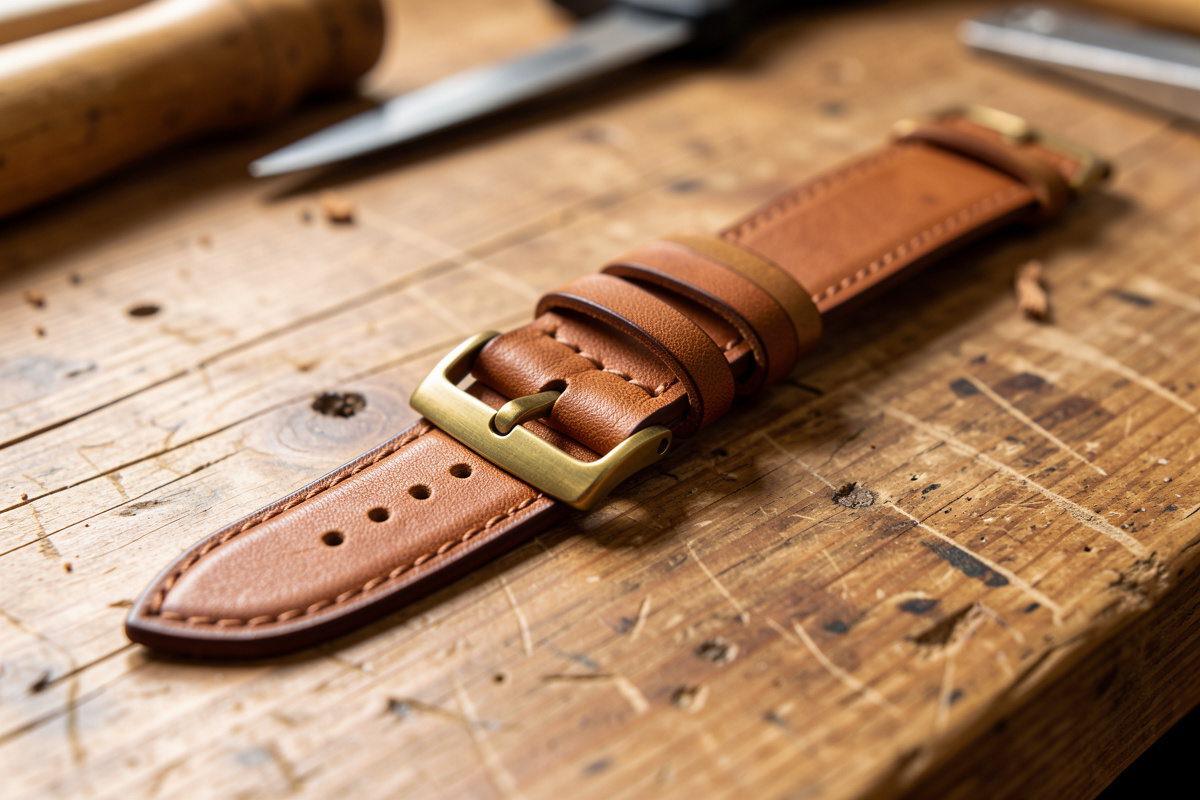
A DIY leather watch strap is the fastest way to learn precision small-goods work: it is two short pieces of 3-4 oz veg-tan, a buckle, two spring bars,…
A DIY leather watch strap is the fastest way to learn precision small-goods work: it is two short pieces of 3-4 oz veg-tan, a buckle, two spring bars, and a single afternoon. My first strap cost about $6 in leather and replaced a $40 factory band that had cracked at the lug. The tolerances are tight, which is exactly why it teaches you more per square inch than any other build.
I have made straps in single-pass and lined two-layer construction, and the lined version is the one worth your time. A watch strap lives against skin and sweat all day, so the edge finish and the lug fit matter more here than on almost anything else I stitch. Get the lug width and taper right and you have a band that looks like it came off a boutique bench.
What Leather and Thickness for a Watch Strap?
A comfortable watch strap runs 3-4 oz veg-tan for a lined strap or a single 5-6 oz piece for an unlined band. Total finished thickness should land around 3.5-4 mm at the lug so it fills the gap without binding the spring bar. Thicker than that and the strap will not bend cleanly around your wrist.
I line my straps with a thin 2-3 oz veg-tan or a soft chrome-tan backing glued flesh-to-flesh, which hides the rough flesh side that otherwise pills against skin. Veg-tan on the grain side takes the burnished edge and the patina; the backing layer is about comfort, not looks. For a single-layer strap I skive the underside near the buckle fold so it wraps without a hard ridge. The same leather weight choices that govern a wallet apply here, just scaled down to a 20 mm strip.
How Do I Measure the Lug Width?
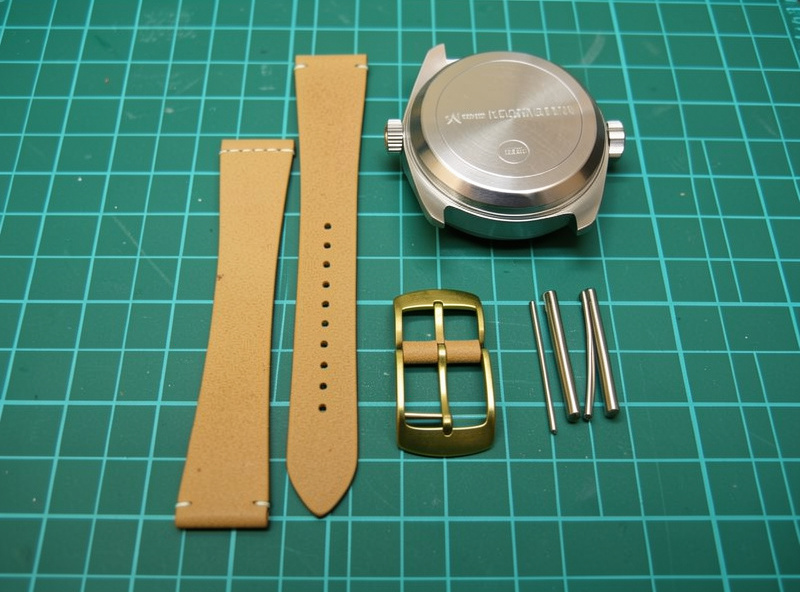
Measure the lug width with calipers across the gap between the watch lugs; common sizes are 18, 20, and 22 mm. The strap must match this exactly, because even a half-millimeter of slop lets the strap shift and a half-millimeter of oversize will not seat between the lugs at all. I cut to the measured number, not a guessed one.
The taper from lug to buckle is a style choice: a 20 mm lug often tapers to 16 or 18 mm at the buckle. I mark the lug end with the caliper measurement, mark the buckle end at my chosen taper, and connect them with a straightedge so both sides of both pieces match. The strap and keeper holes for the spring bar get cut as a slot on the underside of the lug end so the bar tucks in cleanly and the leather folds back over it.
Cutting the Strap and Keeper
Cut two pieces: a long piece (roughly 75 mm of usable length past the lug for the buckle side) and a short piece (about 45 mm) for the holes side, plus one or two keepers. Standard watch strap geometry is a 75/115 split for a roughly 20 cm wrist. I cut both pieces oversize and trim to final fit after the spring bars are set.
The keeper is a small loop, about 30 mm of strip skived thin and wrapped around the strap width plus its thickness, glued and optionally stitched at the joint. I make a floating keeper and a fixed keeper on a dress strap. Cutting these tiny parts is where a fresh blade and a steel straightedge earn their place, because a ragged 20 mm edge has nowhere to hide. The discipline is identical to making a leather belt, only the parts are a tenth the size and twice as fussy.
Setting the Spring Bars and Buckle
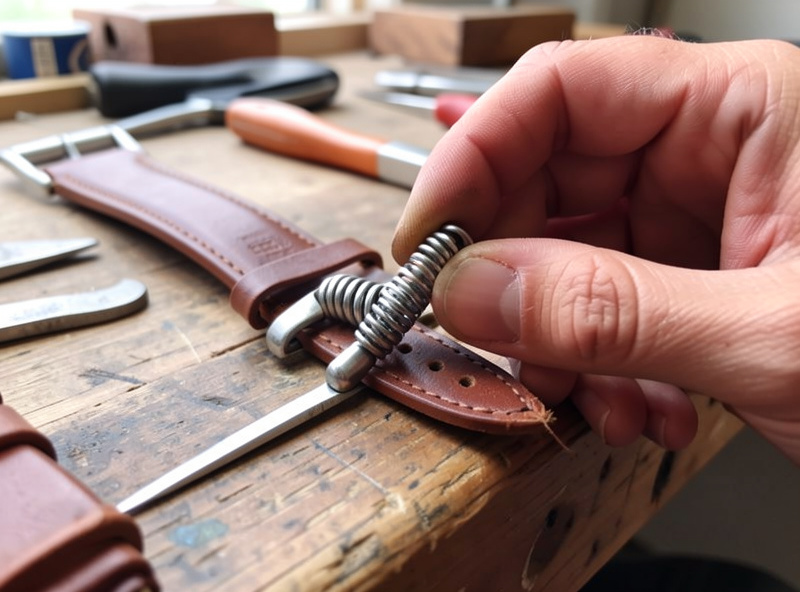
Fold the lug end over the spring bar and stitch it down 3-4 mm behind the bar, leaving the bar free to compress into the lug holes. Use a spring bar tool to seat the bars; a 1.5 mm or 1.78 mm bar diameter is standard for most watches. The fold must be snug enough that the bar does not rattle but loose enough to compress.
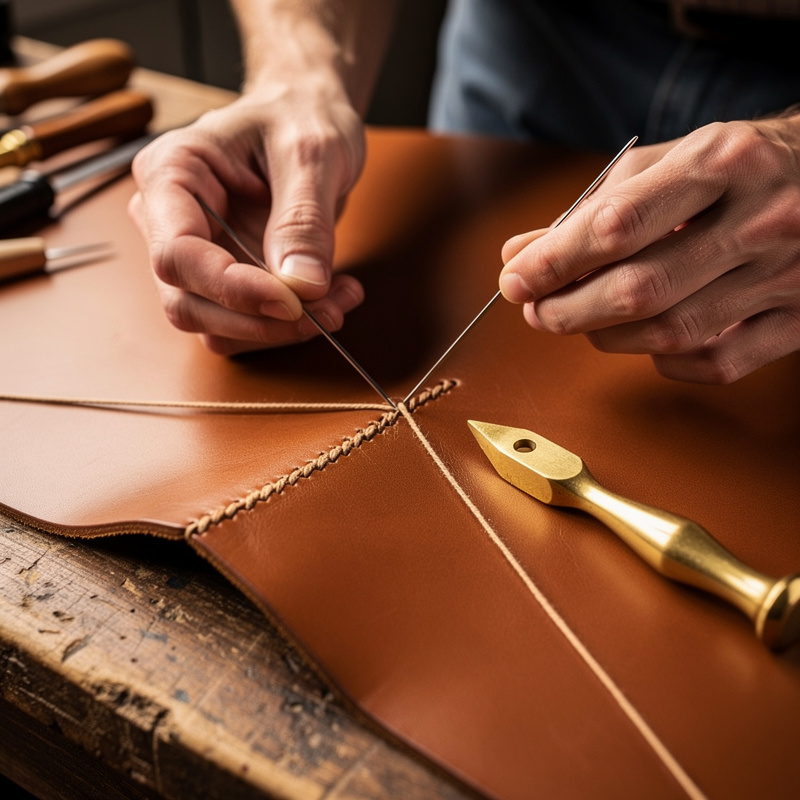
The buckle goes on the long piece the same way: fold over the buckle bar, punch the prong slot, and stitch the fold. I use a small 2.5-3.0 SPI pitch on a strap because the fine pitch suits the scale; a coarse belt-pitch iron looks clumsy here. Saddle-stitch the folds by hand with 0.45-0.6 mm thread so the stitch line stays proportional to the strap. A machine stitch on a strap this small almost always wanders.
Punching the Adjustment Holes
Punch 5-7 holes on the short piece spaced 8-10 mm apart, sized to a 1.5 mm round punch for the buckle prong. Center the middle hole on your measured wrist circumference so you have adjustment in both directions. I measure my wrist with a tailor’s tape and add the case and buckle allowance before marking the center hole.
Mark the hole line down the centerline of the strap with a wing divider so every hole sits dead center; an off-center hole on a 20 mm strap is glaringly obvious. Punch with the strap flat and the punch vertical to avoid ovaling the holes, the same way I punch belt holes, just smaller. A tapered strap means the holes near the buckle sit on narrower leather, so keep the edge margin even rather than the absolute spacing identical.
Stitched vs Unstitched Strap Construction
A stitched strap is stronger and looks more deliberate; an unstitched glued strap is faster but relies entirely on the adhesive at the lug fold. I always stitch the fold at minimum, because that single fold takes the full pull of the watch every time you put it on. A fully stitched perimeter is the dress-strap look most people want.
For the fold, I run a short saddle stitch of 4-6 stitches behind the spring bar with the strap held in the stitching pony. Contact cement alone will eventually creep under daily flex and sweat, so the stitch is the real fastener and the glue just holds alignment while you punch and sew. On a fully stitched strap I run the stitch line about 2.5 mm in from the edge down both long sides, which also pulls the lining and top layer tight so the laminated edge sands flush. The stitch pitch should look proportional, which is why I default to a fine pricking iron rather than the coarser one I keep for belts and sheaths.
Finishing Watch Strap Edges
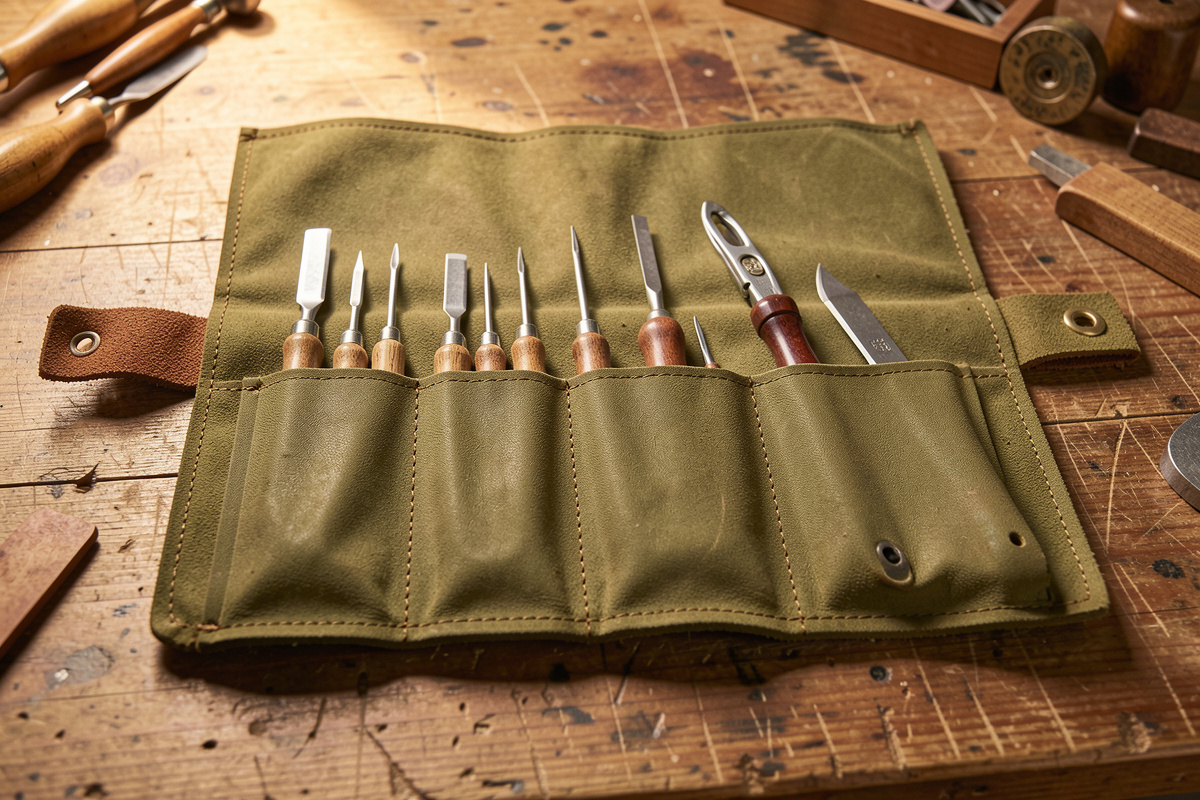
Bevel, sand, and burnish all the edges, because on a strap that sits inches from the wearer’s eye, the edge is the entire impression. I run a #0 or #1 fine beveler, sand to 800 grit, and slick with Tokonole until the edge is glass. A rough edge on a watch strap reads as homemade in the worst way.
On a lined strap I glue the two layers, clamp until set, then sand the laminated edge flush before beveling so the seam disappears into one burnished edge. The narrow profile means I use a small slicker, one of the fine-radius ones I printed in PETG on the workshop printer, because a fat belt slicker overruns a 4 mm edge. Two thin coats of Tokonole with a hard buff between them gives the sealed, rounded edge that survives daily skin contact without fuzzing. The edge is also the part that absorbs sweat first, so sealing it well is what keeps the strap from darkening unevenly at the wrist.
Conditioning and Caring for a Leather Strap
A leather watch strap takes more abuse than any other small good because it sits against sweat, sunscreen, and skin oils every day. A new veg-tan strap gets one light coat of conditioner and a sealed edge; after that, a wipe-down and a re-condition every few months is the whole routine. The enemy is moisture trapped against the flesh side.
I keep the grain side sealed with a thin neutral topcoat so sweat beads rather than soaks in, and I rotate straps so no single band stays damp for days on end. The strap I wear most has darkened to a rich brown at the wrist contact zone, which on veg-tan is desirable patina rather than damage. If a strap does get soaked, I let it air-dry slowly away from heat, then re-condition once it is dry to keep the fibers from stiffening and cracking at the fold. A well-sealed edge and a disciplined drying habit are what separate a strap that ages well from one that rots at the lug in a season.
Frequently Asked Questions
What leather thickness is best for a watch strap?
Use 3-4 oz veg-tan for a lined strap or a single 5-6 oz piece unlined, aiming for about 3.5-4 mm finished thickness at the lug. Thicker leather will not bend cleanly around the wrist or seat the spring bar.
How do I measure watch strap lug width?
Measure the gap between the watch lugs with calipers. Common sizes are 18, 20, and 22 mm, and the strap must match exactly. A half-millimeter oversize will not seat between the lugs and undersize lets the strap shift.
How long should each watch strap piece be?
For a roughly 20 cm wrist, cut a long piece around 75 mm of usable length past the lug for the buckle side and a short piece around 45 mm for the holes. Cut both oversize and trim after setting the spring bars.
What spring bar size do I need?
Most watches use spring bars 1.5 mm or 1.78 mm in diameter, in a length matching the lug width. Use a spring bar tool to compress and seat the bars into the lug holes so the strap pivots freely.
Do I need to line a leather watch strap?
Lining is optional but recommended. A thin 2-3 oz veg-tan or soft chrome-tan backing hides the rough flesh side that pills against skin and improves comfort. An unlined strap works if you skive and seal the flesh side well.
Related Guides
- Leather Projects for Beginners: The Right First Three Builds
- How to Make a Leather Belt: Step-by-Step Tutorial
- How to Make a Leather Card Holder (Slim Wallet Pattern)
- Leather Hardware Guide: Buckles, Rivets, and Snaps