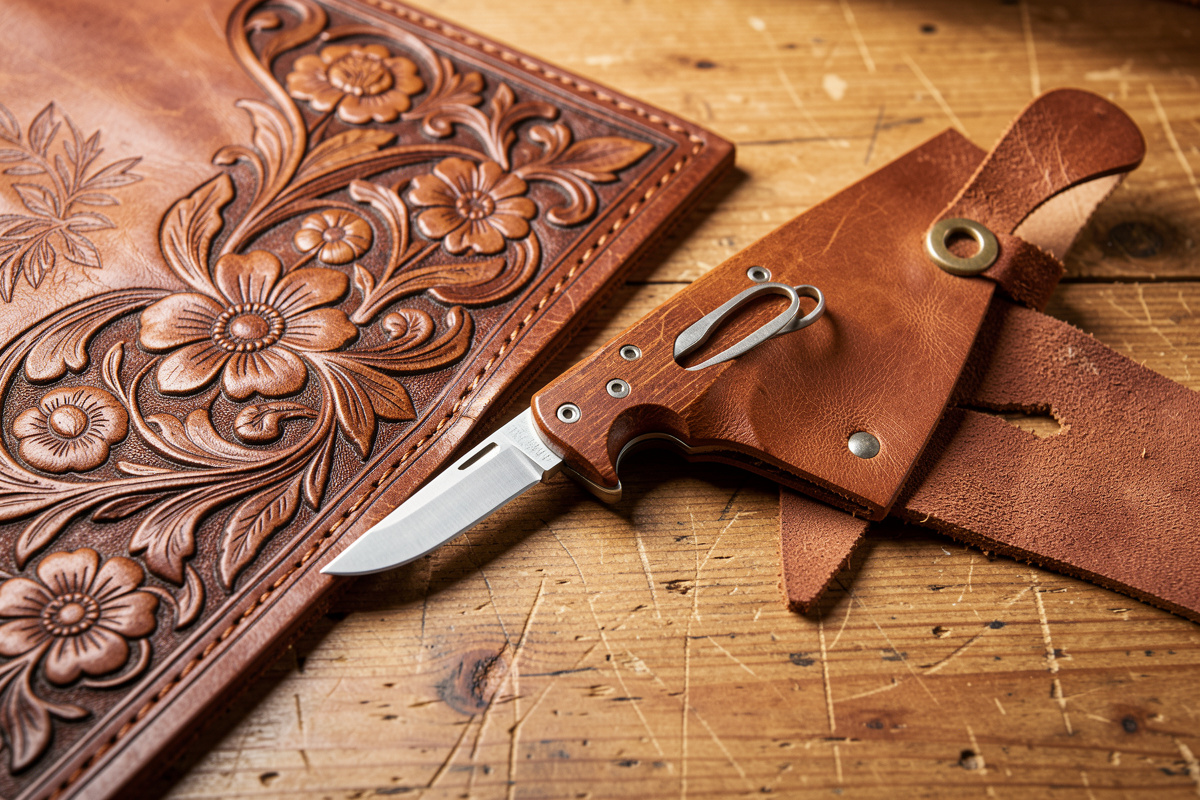
More than any other blade on the leather bench, the swivel knife lives by stropping — a steel blade wants light edge-trailing passes on green or white compound…
More than any other blade on the leather bench, the swivel knife lives by stropping — a steel blade wants light edge-trailing passes on green or white compound every 15 to 20 minutes of carving, and a full regrind only when the strop stops bringing the edge back. Held to that cadence, it scores cased veg-tan in a single sweeping pass and leaves a clean V-groove that springs open behind the blade, with no fuzz and no double-cut. Let the stropping slip and you end up sharpening on the stones far more often, with carved lines that go scratchy inside a single panel.
The blade on a swivel knife is tiny — a hollow-ground steel or ceramic sliver under half an inch across — and because of that it punishes bad sharpening harder than any other tool on the bench. A few careless passes on too-coarse a strop rounds the tip, and the first thing you notice is that your flower petals no longer open cleanly at the curve. I spent one frustrating evening blaming my casing moisture for fuzzy cuts before I realized I had honed a micro-burr onto the blade and was dragging it through the grain with every stroke.
The good news is that the same small size makes the swivel blade the easiest edge on the bench to maintain once you understand the mechanism. There is no freehand angle to hold on a stone, no convex bevel to build — just a charged strop, a consistent edge-trailing motion, and the discipline to stop before the compound rounds the geometry. This guide walks through exactly that, and it is the second of the cluster’s blade-care pieces — the convex head-knife guide covers the cutting blade, and both sit inside the broader complete leather tool care guide.
What Does a Sharp Swivel Knife Cut Feel Like?
Test the blade on a properly cased scrap before you trust it on a panel. A sharp swivel knife drops into the leather under light downward pressure and glides with a faint, dry tick as the grain parts. The groove it leaves is a clean V with crisp walls that visibly relax open a fraction when the blade lifts, because the cased fibers were sheared rather than torn. Run a beveler into that groove and it seats instantly.
A dull swivel knife tells you in three ways. First, the sound: instead of the dry tick you get a fibrous rasp, almost a tearing hiss, as the blade mashes the grain rather than cutting it. Second, the groove: the walls are fuzzy, the bottom is grey and crushed rather than clean, and the groove does not spring back open. Third, the resistance — you start pressing harder, the barrel stops rotating freely in your grip, and your curves get choppy because you are forcing the blade through each arc instead of letting it draw.
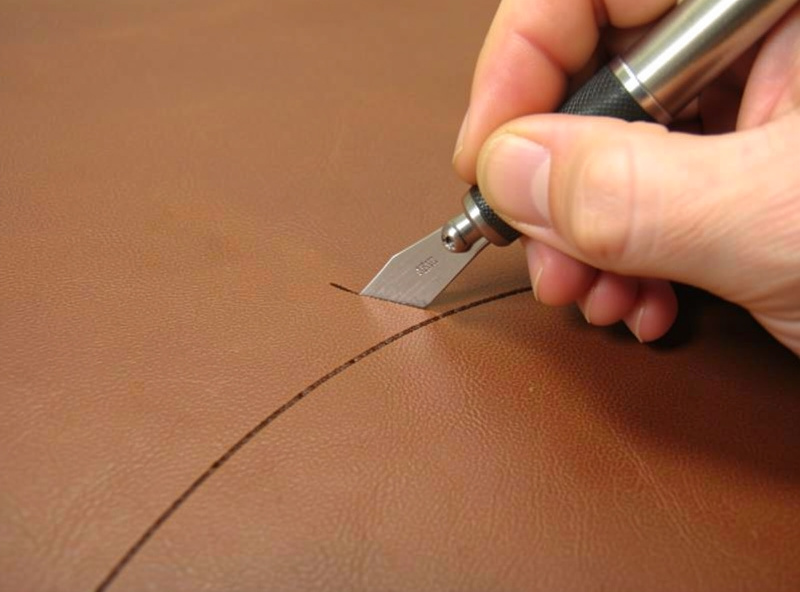
That last symptom is the one that ruins work, because choppy curves are not a sharpening problem by the time you notice them — they are a tooling problem. The beveler will not seat in a furry groove, the backgrounding will not read, and the whole floral panel looks muddy. Sharpening is cheaper than recarving, which is why the discipline of testing the blade on a scrap every 15 minutes matters more than the actual honing technique. The floral tooling pattern guide walks through the carving sequence; none of it works without the sharp score line underneath.
How Do You Strop a Swivel Knife Blade?
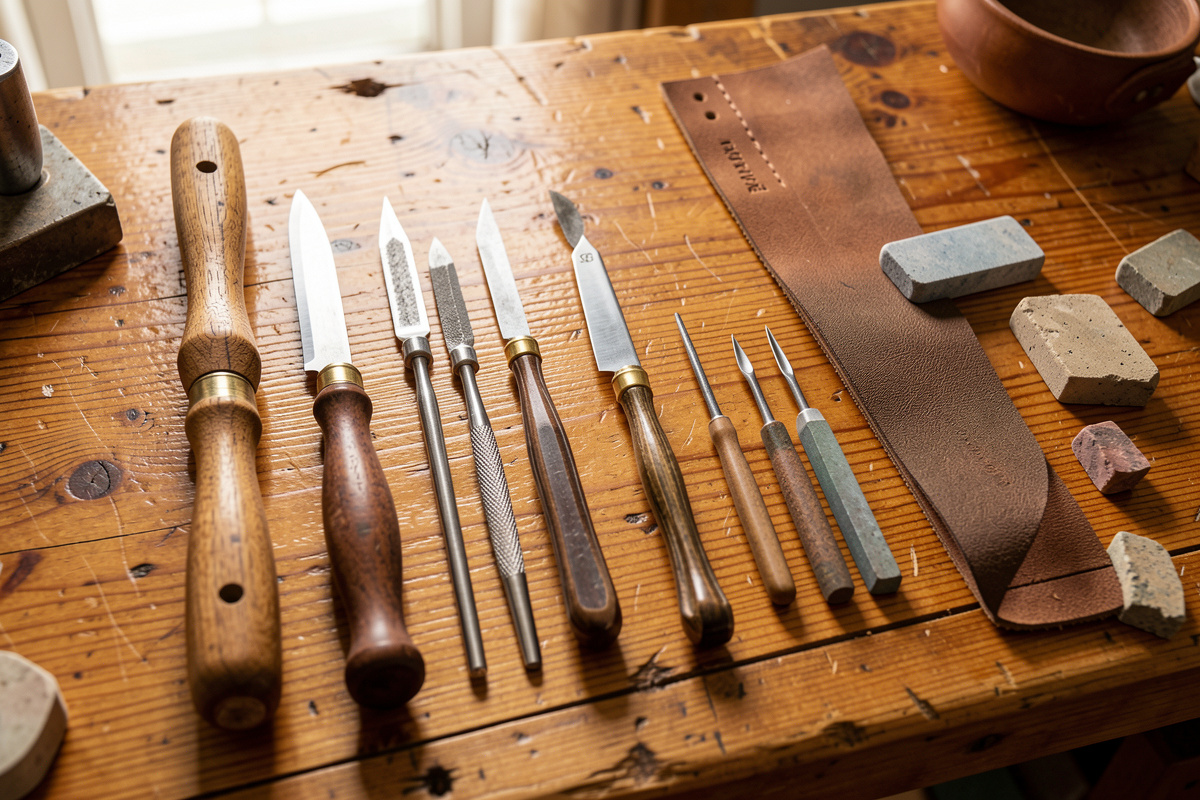
Charge a narrow strip of veg-tan leather — flesh side up, mounted so it will not slide — with a light coat of green (chromium oxide) or white (aluminum oxide) compound, and draw the blade across it edge-trailing, spine-first, five to eight passes per side. Rotate the blade as you draw so the whole curved cutting edge contacts the leather, from the heel through the tip. No pressure beyond the weight of the knife, and never more than about ten passes in a session.
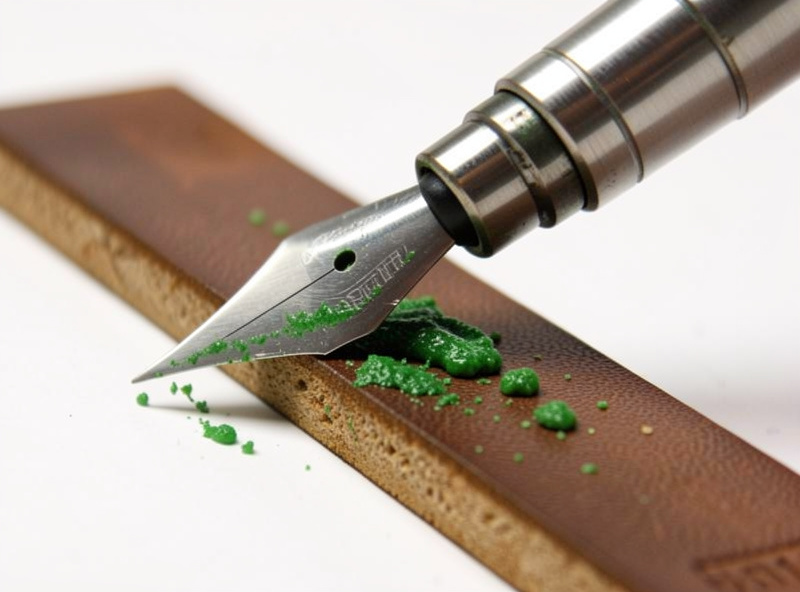
Edge-trailing is non-negotiable on a blade this small. Lead with the edge into the leather and the compound digs a burr onto the far side; that burr folds the instant you cut with the blade, and every score line drags. The motion I teach is to imagine pulling the blade backward by its tip — the spine leads, the edge trails, and the compound gently polishes and realigns the apex rather than grinding it. This is the same edge-trailing principle documented in the electron-microscopy work at Science of Sharp, where stropping is shown to realign the apex and lay down a thin convex polish at the very tip — which on a swivel blade is exactly the geometry that lets it shear cased grain cleanly.
Two compound choices matter. Green chromium oxide (Cr₂O₃, roughly half a micron to one micron) gives a high polish and is my default for routine touch-ups — it realigns without removing much steel, so you can strop often without shortening the blade’s life. White aluminum oxide (around five to fifteen microns) cuts faster and is what I reach for when the blade has gone a little too long between stroppings and needs real metal removed. A leather strop charged with green compound is the one bench item I keep in stock at the bench at all times, because every blade in the cluster touches it. As an Amazon Associate I earn from qualifying purchases.
Steel vs Ceramic Swivel Blades — Which Sharpens How?
Steel swivel blades (the standard on Tandy Craftool, Barry King, and most Pro-grade knives) are stropped exactly as above and will take a stone if they ever need it. Ceramic blades are different: you do not strop a ceramic blade at all, because the leather’s give and any trapped grit can chip the brittle edge, and ceramic does not form the same foldable burr that stropping is meant to fix. A ceramic blade gets touched up — rarely — on a fine diamond pad, or simply replaced when it dulls.
The trade-off is real and worth knowing before you buy. Ceramic holds a working edge far longer than steel — often months of casual carving where a steel blade wants a strop every session — but it pays for that in brittleness. Drop a ceramic blade on the bench, catch it on a stamp, or try to strop it the way you strop steel, and you have a chipped edge no amount of honing will save. The care guidance from ceramic-knife makers like Kyocera is blunt on this point: ceramic edges require diamond abrasives and cannot be treated like steel. That maps directly to the swivel blade — if you run ceramic, buy a spare and a diamond pad; if you run steel, learn to strop.
My own bench runs steel. I keep one Barry King barrel with a fine steel blade as my daily carver and a backup blade in the drawer, because the thing that ends a carving session fastest is a chipped tip mid-petal and no sharp blade to swap in. Ceramic I leave to carvers doing long production runs of the same motif; for the variable, stop-and-start hobbyist work most of us do, steel plus a strop is the lower-stress choice. The carving tools guide breaks down the full swivel-knife selection in more detail.
How Do You Fix a Dull Swivel Knife Tip?
The tip goes first, almost every time, because it does the tightest curve-work and takes the most lateral stress. You feel it as a shallow or skidding start to each cut — the blade wants to skip rather than bite at the beginning of a stroke. The fix is not more stropping; it is a targeted hone on a fine ceramic or hard Arkansas slip stone, drawing only the very tip edge-trailing across the stone at the blade’s existing angle, two or three passes, then back to the strop.
What you are fighting here is a geometry drift, not a sharpness problem. Repeated stropping on a flat strop wears the belly of the blade slightly faster than the tip (because the belly contacts the leather more squarely), and over weeks the tip ends up riding a hair above the cutting plane. A few passes on a slip stone re-establishes the continuous curve from heel to tip, after which the strop keeps it honest again. If you do not own a slip stone, a fine ceramic rod (the kind sold for kitchen knives) laid flat on the bench works — draw the blade across it edge-trailing, rotating to follow the curve.
The mistake I made once and will not repeat: trying to fix a rolled tip by pressing harder on the strop. Extra pressure on compound does not reshape geometry — it just rounds the apex further and loads the leather with steel that then scratches the next blade. When stropping stops fixing the tip, reach for the stone, not for more pressure. This is the same rule that governs every blade on the leather bench — strop to maintain, stone to repair.
How Often Should You Hone a Swivel Knife?
Strop a steel swivel blade every 15 to 20 minutes of active carving, or any time the test-scrap cut goes from a clean tick to a fibrous rasp. Do a tip-touch on a slip stone when the start of each cut skids, which in practice means every few sessions of heavy floral work. A full regrind — sending the blade back to a maker or working it on a guided jig — happens only when both stropping and the slip stone stop restoring the edge, usually after a year or more of regular use, or immediately after a chip.
Ceramic is the inverse schedule: nothing for months, then a diamond touch-up or a replacement. The psychological trap with ceramic is that because you never strop it, you also never test it — and a ceramic blade that has silently dulled will ruin a panel before you notice the resistance has crept up. Test-scrap it the same way you test steel, on the same cadence, even though you are not touching it up between tests.
Whatever blade you run, the habit that saves the most work is the test-scrap before every panel, not the honing itself. A swivel knife does not go dull mid-cut the way a head knife does; it drifts slowly, and the drift is invisible until the beveler refuses to seat. Five seconds on a cased offcut tells you everything. For someone just starting out, the beginner tooling guide builds that test-before-you-cut habit in from the first project.
Do you strop a swivel knife blade?
Yes, if it is steel. Five to eight light edge-trailing passes on green or white compound every 15 to 20 minutes of carving keeps the apex aligned. Ceramic blades are never stropped; the leather and grit chip the brittle edge.
Can you sharpen a ceramic swivel knife blade?
Only with a fine diamond abrasive. Ceramic does not form the foldable burr that stropping fixes and chips easily, so most carvers touch it up rarely on a diamond pad or replace the blade when it dulls.
Why does my swivel knife skip at the start of a cut?
The tip has gone dull or drifted above the cutting plane from uneven stropping. A few edge-trailing passes on a fine slip stone re-establishes the curve from heel to tip, then return to the strop for routine maintenance.
How often should I strop a swivel knife?
Every 15 to 20 minutes of active carving, or any time a test cut on cased scrap turns from a clean dry tick into a fibrous rasp. Pressure never fixes a dull blade; reach for the stone when stropping stops working.
Keep Building
- Maintaining Leather Tools: The Complete Care Guide
- How to Sharpen a Head Knife: The Convex Edge That Slices Clean
- How to Sharpen and Strop a Diamond Awl So Stitches Seat Right
- How to Strop Leather Tools: Compound, Direction, and How Often
- Best Sharpening Stones and Strops for Leatherwork