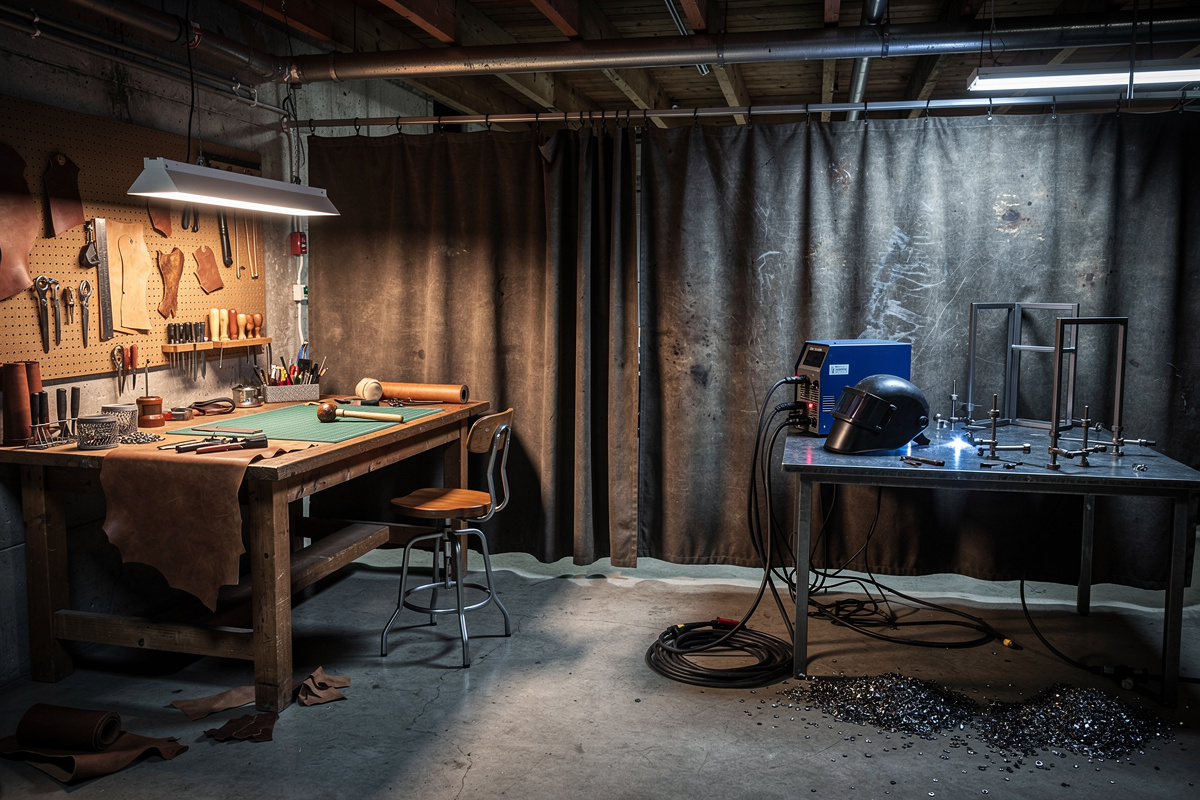
Leather dye solvents and contact cement vapor ignite at temperatures a welding spark hits in flight, and sparks off a 4.5-inch grinder wheel travel 30–35 feet on a…
Leather dye solvents and contact cement vapor ignite at temperatures a welding spark hits in flight, and sparks off a 4.5-inch grinder wheel travel 30–35 feet on a hard concrete floor. Running both hobbies in the same shop is workable, but the safe layout is non-negotiable: a 35-foot fire-safe radius around the arc, a full 1-hour fire watch after the last bead, and a fire-rated curtain between the two benches. Skip any of those and the question is when, not if.
My shop runs leather tooling on the east bench and a YesWelder MIG-PRO205DS on the west bench, 18 feet apart with a 6-foot Tillman 590 fire-rated curtain between them. The curtain went up the week I almost set a $40 piece of 8–9oz veg-tan on fire by skipping the fire watch entirely — I’ll get to that scene below. What I want to lay out first is the contradiction that catches every mixed-shop builder: the dust collector that safely catches leather buff dust will detonate the day you connect it to a welding fume line. They look like the same problem. They are not.
The welding-side fume capture and PPE detail lives on homewelder.com’s welding safety guide. This article is the mixed-shop layer: the layout math, the hot-work discipline, the ventilation separation, and the named gear that actually keeps leather and welding under one roof without an insurance claim.
The Fire-Safe Workshop Layout
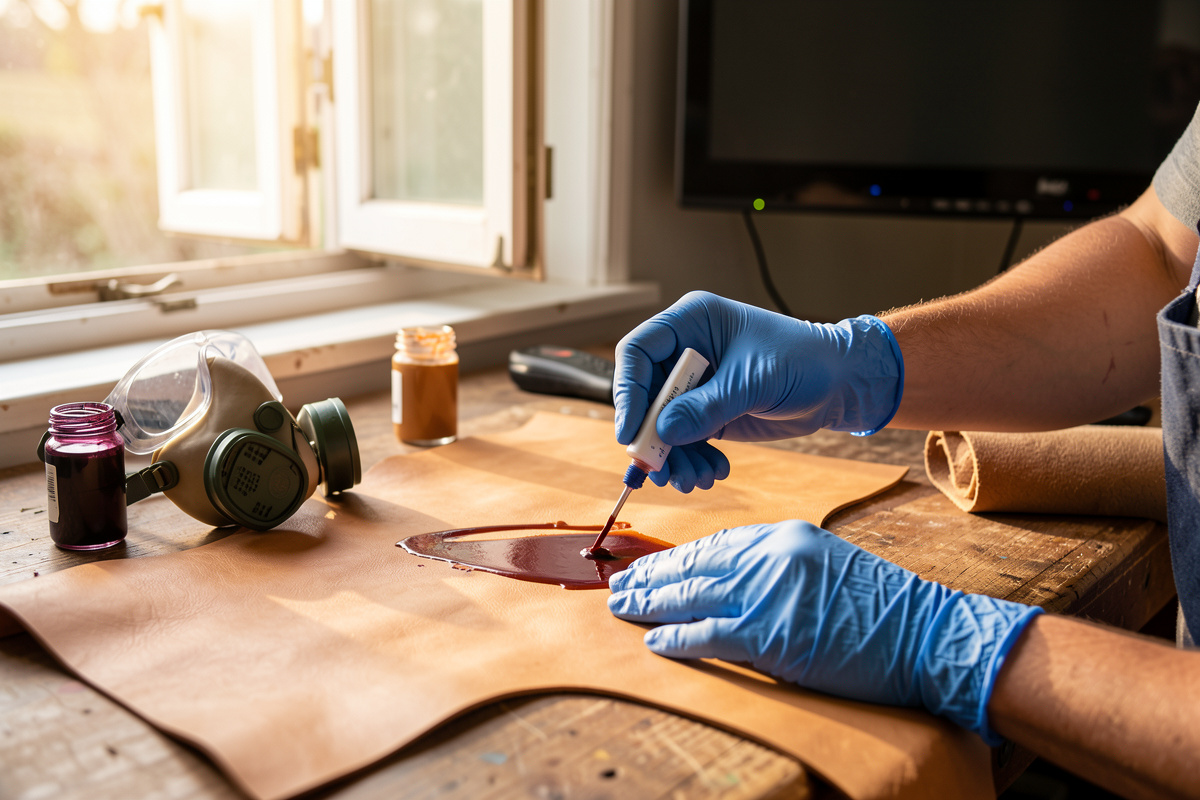
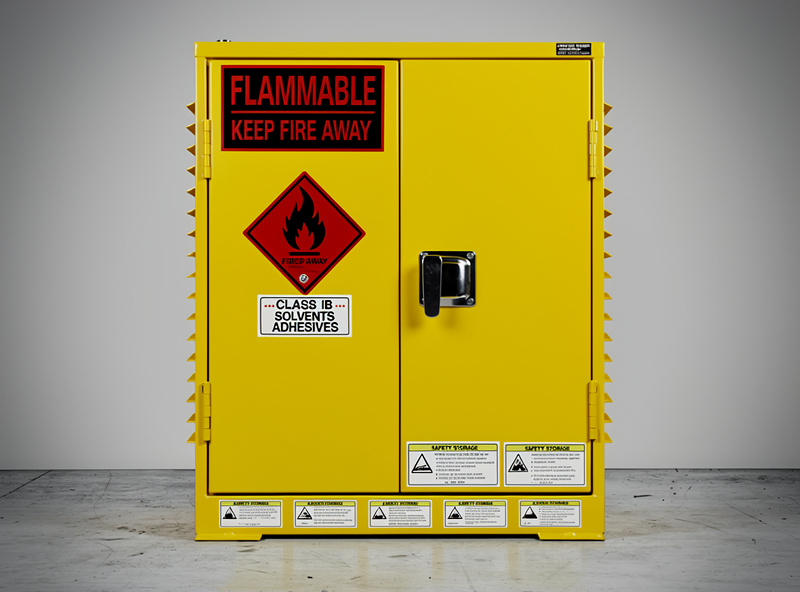
OSHA 29 CFR 1910.252(a)(2)(iv) sets the standard most home shops never read: a 35-foot fire-safe radius around any hot-work operation, free of combustibles, or — if 35 feet is impossible in a one-car garage — fire-resistant guards in place. My shop is 22 feet end-to-end, so the guard is mandatory. The curtain (24 oz/yd² acrylic-coated fiberglass, welding-rated) blocks sparks, slag, and UV. Leather solvents — acetone, denatured alcohol, Fiebing’s dye thinner — live in a steel flammable cabinet with a self-closing door, positioned at least 10 feet from the arc. Contact cement and any spray adhesive cans go inside the same cabinet, lid down.
The rule is absolute. No open container of flammable liquid on any work surface while the arc is live. Spray adhesive propellant (butane, propane, or DME) drifts 20–30 feet and ignites from an arc with a soft, blue flash you won’t forget — there’s no published standard number for how long that propellant lingers in a home-shop-sized space, so I run my own conservative floor: no welding until the can’s back in the cabinet AND I can no longer smell propellant in the air, thirty minutes minimum even in a well-ventilated shop, longer if the exhaust fan wasn’t running during the spray.
Hot-Work Permit Discipline for Mixed Shops
NFPA 51B (Standard for Fire Prevention During Welding, Cutting, and Other Hot Work) is the document a commercial fire marshal will quote at you after an incident, and it is the document worth reading before one. Two requirements matter for a home shop: the 35-foot combustible-free radius (which lines up with the OSHA 1910.252 language) and the post-work fire watch — OSHA’s own regulatory floor is a half hour, but NFPA 51B’s 2019 revision (Section 5.6.1.1) raised the required fire watch to a full hour after the last bead, with continuous monitoring throughout and further periodic checks after that if the risk warrants it. Follow the current, more conservative standard, not the old 30-minute number still floating around older forum posts and blog write-ups.
A “hot-work permit” in a hobby shop is not a piece of paper from a safety officer. It is a checklist you run before you strike an arc. Mine is taped inside the door of the flammable cabinet, in this order: solvent containers closed and stored; leather scraps swept and binned; curtain pulled across the rail and weighted at the floor; ABC extinguisher within arm’s reach; phone in pocket; fire-watch timer set on the bench. Leather scraps amplify the welding fire risk in a way most welders underestimate. Veg-tan offcuts and chrome-tan scraps smolder before they flame — they catch a spark, glow for 15 to 40 minutes with no visible smoke, then erupt into open fire after you have left the building.
That delay is exactly why the current fire-watch standard runs a full hour, not the old 30 minutes — a smoldering veg-tan or chrome-tan scrap can sit well past the half-hour mark with no visible smoke. Stay in the shop. Watch the floor. Walk a slow lap every five minutes. Set a timer. Do not leave.
Ventilation Math: Why a Welding Fume Hood Won’t Catch Solvent Vapor
Welding fume is hot, particulate, and rises fast. Solvent vapor is cool, gaseous, and heavier than air. The capture-velocity targets are different by a factor of three, and the duct geometry that works for one strangles the other. ACGIH publishes capture velocity ranges for industrial ventilation: welding fume needs 100–200 ft/min at the source, while solvent vapor evaporating from an open container needs 50–100 ft/min at the surface and pulls best from a low intake (because the vapor sinks).
The CFM math for a typical 200-square-foot home shop: at 100 ft/min capture velocity, a 12-inch hood at 18 inches from the arc needs roughly 400 CFM. A solvent-finishing bench with a 24-inch low-draw slot needs 600–800 CFM at the slot to clear vapor before it pools at floor level. Sharing one fan splits the airflow and neither side works. Worse, sharing one duct mixes hot metal particles with combustible vapor — that is the explosive condition NFPA 654 (combustible dust) was written to prevent.
The fix is two independent ventilation systems. A welding fume extractor (Lincoln Miniflex, Miller FILTAIR 130, or a comparable 100-400 CFM portable with HEPA + activated carbon stages) sits at the west bench. A separate exhaust — box fan with a Honeywell HEPA pleated furnace filter on the intake, or a small inline duct fan vented through the wall — sits low at the east bench for solvent work. They never share a duct. They never run simultaneously unless the welding extractor is filtered upstream of any vapor source, which in a hobby shop is almost never the case.
Ventilation for a Mixed Workshop
Welding produces metal fume particulates — iron oxide, manganese, hexavalent chromium from stainless. Leather finishing produces VOCs from dyes, solvents, and adhesives. The two pollutants need different filters and different fans, but they share one rule: run the exhaust for 15 minutes after the last operation, every time. The welding extractor stays on through the fire-watch window. The solvent exhaust stays on until the bench surface is dry to the touch and the cabinet door has been closed for ten minutes.
A welding fume extractor with an articulated arm pulled to within 8 inches of the weld captures roughly 90% of fume before it enters room air. Past 12 inches the capture rate falls off a cliff. On the leather side, a box fan with a Honeywell HEPA furnace filter taped to the intake handles buff dust and overspray. Use a HEPA fan, not a standard shop vac — buff dust is a combustible-dust hazard and a brushed shop-vac motor sparks.
Sensory Cues That Save the Shop
Burning leather has a specific smell. Sweet-acrid, like singed hair mixed with old caramel — not the dry wood-fire smell most welders expect from a smoldering scrap. The chemistry is protein versus cellulose. Wood smells like wood. Leather smells like a barbershop and a campfire had an accident. If you smell that and you cannot see flame, the scrap is already smoldering somewhere you have not looked yet.
Spark trajectory off a DeWalt DWE402 grinder wheel is a flat orange arc, low to the floor, that bounces twice before it dies. Off a MIG arc the sparks are smaller, hotter, and travel in a tighter cone — but a single bounce off a clamp can send one 15 feet sideways. The fire-rated curtain edge in your fingers feels heavy, almost canvas-stiff, with a fiberglass weave that scratches like steel wool. A regular shop tarp feels like a grocery bag. The difference is what your shop is worth.
The Mistake That Built My Fire-Watch Habit
Saturday afternoon, two summers ago, I was finishing a small bracket weld on the MIG. The bead looked good, the shop was quiet, and I had a dinner I was late for. I shut the welder down, hung the gun, took the helmet off, and walked out. No fire watch. Came back ninety minutes later to a smoldering scrap of 8–9oz veg-tan on the east bench floor, edge curling black, sweet-acrid smoke pooling at chest level. A spark had drifted under the curtain edge where the weight had shifted — the curtain was not floor-sealed — and landed in the scrap pile I had not swept. Twenty more minutes and that scrap would have lit the bench. The lesson named itself: the fire watch is non-negotiable, and the curtain has to be weighted to the floor on both ends, not just hung from the rail. I run a full 60-minute timer on every weld now, not the 30 I used to think was enough — the smolder window on veg-tan scrap alone justifies the extra half hour. The timer beeps before I leave. No exceptions.
The Named Gear That Earns Its Place
Some of this kit gets bought once and forgotten. Some of it I have rebought after learning the cheap version fails at the worst moment. The list below is what is actually in my shop today, with the reason it beat the alternatives.
As an Amazon Associate I earn from qualifying purchases.
- Tillman 590 fire-rated welding blanket (24 oz acrylic-coated fiberglass, 6×6 ft) — drapes over the leather bench and tool roll when I weld nearby. The Tillman weave holds up to repeated spark contact; the $15 hardware-store “welding blankets” char through in two sessions.
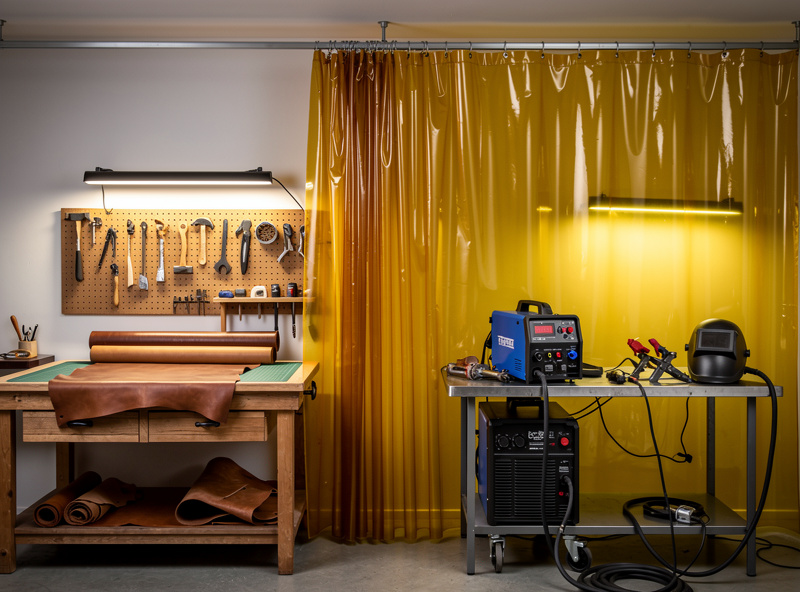
- Steiner 333 ArcView welding curtain (14-mil tinted transparent vinyl panel, steel frame) — between the benches, lets me see the leather bench while welding so I notice smoke or movement. Solid fiberglass blankets like the Tillman save sparks but blind you; the vinyl trades some spark resistance for visibility.
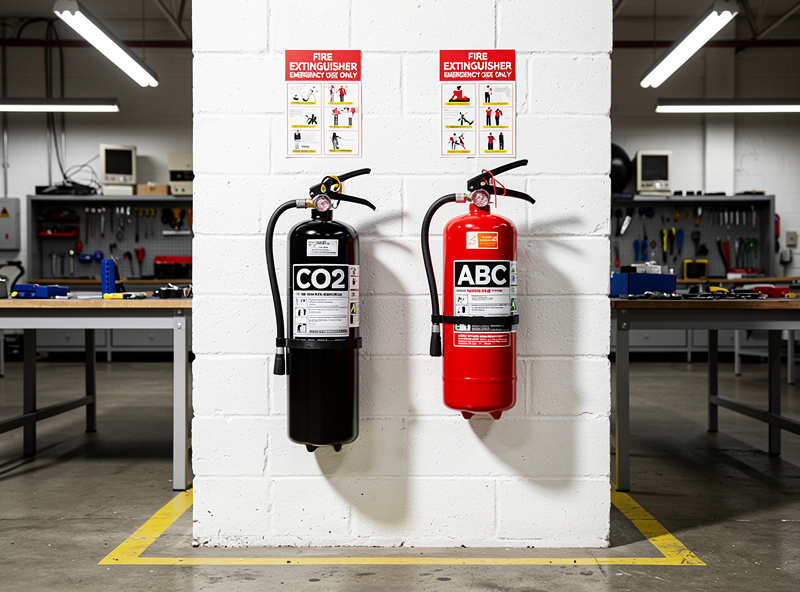
- 5-lb ABC dry-chemical extinguisher (Amerex or equivalent certified brand) — mounted between benches, accessible without crossing either work zone. 5 lb is the minimum useful size; the 2.5-lb kitchen-grade unit empties in 8 seconds and won’t reach a curtain fire.
- Tandy edge slicker (cocobolo) — east bench, near the dye station. Wooden, dense, ignites at higher temp than the plastic slickers, and the small mass means a spark that lands on it dies cold.
- Fiebing’s neatsfoot oil — flashpoint above 400°F, safer than the linseed-and-solvent blends some leatherworkers prefer. Still gets cabinet-stored when the welder is running.
- Honeywell HEPA pleated furnace filter on a 20-inch box fan — east bench dust capture. The HEPA pleat catches buff dust the standard MERV-8 filter misses.
- Bessey GSCC clamps on the welding bench (no plastic handles in the spark zone) and a steel-handled DeWalt DWE402 grinder for cut-off work.
If I Were Setting Up a Mixed Leather + Welding Shop Today
If I were starting over with a one-car garage and a budget under $800, I would do it in this order. One: hang a Steiner 333 or Tillman 590 curtain between the two zones, floor-weighted on both ends, before either bench gets built. Two: install a steel flammable cabinet on the leather side and never let an open solvent container exit it during a hot-work session. Three: buy a 400-CFM welding fume extractor with an articulated arm — do not try to make a shared shop-vac do this job. Four: mount a 5-lb ABC and a 5-lb CO2 between the benches, set a 60-minute fire-watch timer on the wall per current NFPA 51B, and treat the timer as the law. The welding-side ventilation deep dive — capture velocities, filter staging, hexavalent-chromium handling — lives on homewelder.com’s welding safety guide. Read it before the first arc strike.
Frequently Asked Questions
Can leather dust catch fire from welding sparks?
Yes. Leather dust from sanding and buffing is a combustible dust. Accumulated dust on surfaces and in exhaust ducts can ignite from a welding spark landing in it. Clean all leather dust from surfaces within 20 feet of the welding station before striking an arc. A shop vacuum with a HEPA filter handles leather dust safely; never use a standard shop vac for combustible dust without a spark-proof motor.
What is the most dangerous combination in a mixed leather and welding shop?
Spray adhesive propellant and welding arcs. Aerosolized contact cement propellant (typically butane or propane) can travel 20–30 feet from the spray point and ignite from a welding arc. There’s no published standard interval for propellant dissipation in a home-shop space, so treat 30 minutes as a personal conservative floor, not a regulatory number: wait until you can no longer smell propellant and the can is back in the cabinet before striking an arc. A combustible gas detector ($30) near the welding station provides an additional safety layer.
Do I need two different fire extinguishers for leather and welding?
Yes. A CO2 extinguisher for welding (effective on electrical fires and does not contaminate welds with powder residue) and an ABC dry-chemical extinguisher for leather chemicals (effective on solvent and adhesive fires). Mount both between the two workstations, accessible without crossing either work zone.
Can I use a single dust collector for both leather buffing and welding fume?
No, and trying it is one of the fastest paths to a shop fire or explosion. Leather buff dust is a combustible dust under NFPA 654; welding fume contains hot metal particles capable of ignition. Combining them in one duct mixes fuel and ignition source in a confined space. Use two independent systems: a HEPA fan or dust collector with a spark-proof motor for leather, and a dedicated welding fume extractor with HEPA plus activated carbon stages for the arc.
What is the cheapest compliant fire-rated curtain for a 1-car garage?
Tillman 590 (24 oz/yd² acrylic-coated fiberglass, opaque, maximum spark protection) or Steiner 333 ArcView (14-mil tinted transparent vinyl, lets you see through it) in a 6×6 ft panel run roughly 35 to 75 dollars at most welding suppliers, depending on retailer. The $15 hardware-store welding blankets are a different, thinner product and will char through in two or three sessions. Floor-weight the bottom edge so sparks cannot drift underneath; that single detail prevents the most common smolder-fire scenario in mixed shops.
Do I need an OSHA hot-work permit for a hobby home shop?
OSHA 29 CFR 1910.252 applies to workplaces, not private hobby shops, so a formal permit is not legally required. But the underlying NFPA 51B checklist is the right discipline for any home shop where leather scraps and welding share a roof: 35-foot fire-safe radius, continuous fire watch during the work, and a full 1-hour fire watch after the last bead (NFPA 51B’s 2019 revision raised this from the old 30-minute figure), with further periodic checks after that if the risk warrants it. Treat the permit as a personal pre-flight checklist taped inside the flammable cabinet door; the standards exist because the failure modes are real, not because a regulator is watching.
Related Articles
- Leather Working for Beginners: Complete Starter Guide
- Leather Dyeing: The Complete Veg-Tan Guide
- Leather Edge Finishing Guide
- Leather Stitching Techniques Guide
- Leatherworking Tools Guide