What separates a $200 hand-stitched wallet from a $20 wallet at the mall isn’t markup — it’s that almost none of the mall wallet’s price is labor, and…
What separates a $200 hand-stitched wallet from a $20 wallet at the mall isn’t markup — it’s that almost none of the mall wallet’s price is labor, and almost all of the hand-stitched one’s is. A bifold wallet built on a home bench with a saddle stitch, a proper edge finish, and tannery-sourced veg-tan can run six to ten real hours of skilled work before it’s done, and every one of those hours shows up in the piece if you know where to look. This guide is about what you’re actually paying for when you buy handmade leather — not a formula for pricing it to sell, but an honest walk through where the value comes from so you can tell a well-made piece from an overpriced one. For the companion piece on evaluating quality directly, see the handmade leather goods buyer’s guide.
The short version: value in a hand-stitched leather piece comes from four places — the leather itself (grade, tannage, and which tannery it came from), the hardware, the stitching and edge work, and the hours a real maker put into it. Skimp on any one of the four and the piece looks or wears cheap regardless of what it’s priced at. Overpay for a piece that’s weak in all four and you’re paying for a story, not craftsmanship. This guide walks each one so you know what you’re looking at.
I built my first ten wallets out of the cheapest chrome-tan offcuts I could find and stitched them with a machine-pitch iron that was wrong for the thread I was using. They looked fine in a photo and fell apart at the edges within a year — the corners frayed, the dye rubbed off in patches, the stitching loosened because the lock wasn’t seating right. Switching to tannery veg-tan, a properly matched iron-and-thread pairing, and actually finishing the edges instead of just trimming them changed everything about how the pieces held up. That’s the difference this guide is about — not a pricing trick, but what actually makes a piece worth the hours it took.
What “Handmade” Actually Means
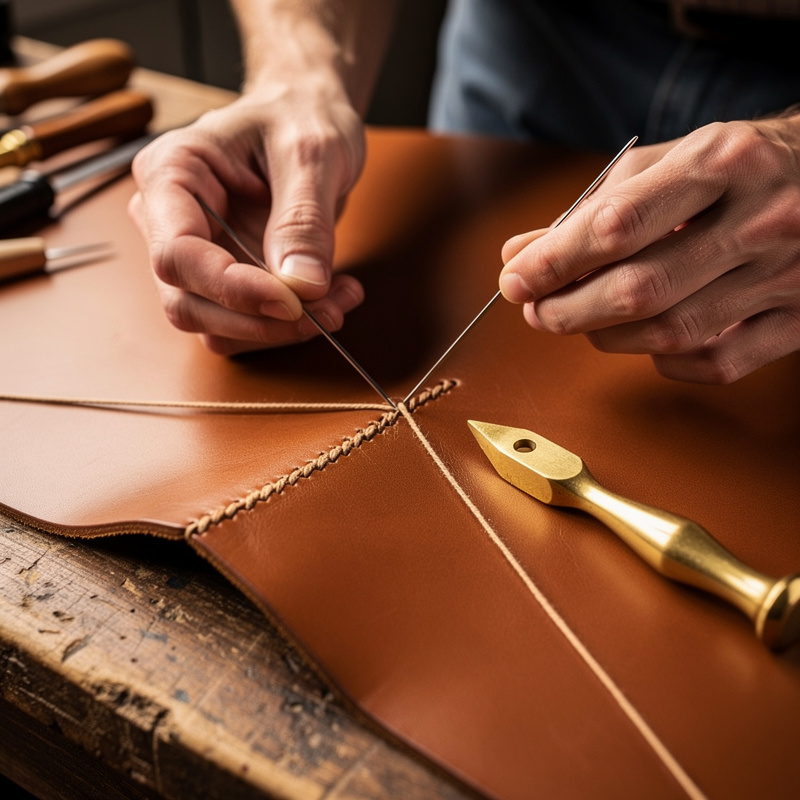
“Handmade” gets used loosely, and it covers a wide range of actual labor. On the low end: machine-stitched panels assembled from die-cut pieces, hand-finished at the edges — real work, but a fraction of the hours of a fully hand-stitched piece. On the high end: leather that’s hand-cut from a pattern, hand-skived at the seams, hand-stitched with a saddle stitch (two needles, one thread, locked at every hole), and hand-finished at the edge through a full bevel-sand-slick-wax sequence. The saddle stitch alone is the biggest labor difference — it’s slower than a machine lockstitch by an order of magnitude, and it survives a machine stitch snapping because each stitch is independently locked rather than sharing one continuous thread.
The tell for genuinely hand-stitched work is on the back of the piece: saddle-stitched thread sits identically on both faces, with a slight diagonal lean at each hole from the awl angle. A machine lockstitch looks different front to back — one face shows a straight running stitch, the other shows small locking loops. Neither is dishonest, but a maker charging saddle-stitch prices for machine-stitched work is not being straight with buyers, and it’s worth knowing the difference before you pay for it.
Leather Grade and Tannage Drive Most of the Value
The leather itself is usually the single biggest quality variable, and it’s also the easiest to fake in a photo. Two things matter: grade and tannage. Grade is about how much of the natural hide surface survives — full-grain keeps the outer layer with its natural texture intact and improves with wear; top-grain is sanded and often coated to hide imperfections, which looks cleaner on day one and wears worse over years because the coating cracks rather than patinas. My own full-grain vs top-grain breakdown goes deeper on the durability difference and what each one is actually good for.
Tannage is the other half. Vegetable-tanned leather (veg-tan) is tanned slowly with plant tannins, holds tooling and stamping, takes dye evenly, and ages into a deep patina with handling and sun exposure — it’s the leather I reach for on wallets, belts, and sheaths where structure and burnished edges matter. Chrome-tanned leather is tanned quickly with chromium salts, stays soft and pliable, and is the right call for bags and soft goods, but it won’t hold a burnished edge the way veg-tan does and won’t develop the same patina. Neither is “better” in the abstract — a maker using chrome-tan on a structured wallet, or veg-tan on a slouchy bag, is using the wrong leather for the job, and that mismatch is worth noticing.
Tannery matters more than most buyers realize, because tannage quality varies enormously even within “veg-tan.” The tanneries whose shoulders and bends end up on serious benches — Horween, Wickett & Craig, and Hermann Oak among them — run consistent temper and thickness across a hide, so the leather behaves the same at every cut. Bargain-bin veg-tan can vary in thickness by a millimeter across one panel, which throws off skiving and shows up as an uneven edge later. A maker who names their tannery in a listing or conversation isn’t showing off — they’re telling you something real about consistency you can’t see in a photo.
Hardware Quality Is a Value Signal Buyers Miss
Hardware — snaps, rivets, buckles, D-rings — gets far less attention than leather but fails far more visibly. Solid brass or solid nickel-silver hardware costs meaningfully more than plated pot metal, but it doesn’t rust, doesn’t flake, and the finish is the same all the way through if it ever gets scratched. Plated hardware looks identical to solid hardware on day one and reveals itself within a year — a scuffed edge shows a different-colored base metal underneath, and prolonged pocket or bag contact eventually corrodes the plating at contact points.
Rivets and snaps are worth checking specifically because they’re a common corner-cut. A properly set rivet sits flush and doesn’t wiggle; a poorly set one either sits proud (caught the leather at a bad angle) or spins loose within months. Solid brass snaps from a hardware maker like Tandy or a specialty supplier cost several times what a bargain multi-pack runs, and the difference is entirely in the plating thickness and the spring tension of the socket — the part you feel every time you open the wallet.
The Edge Finish Is the Single Biggest Tell
If I had to pick one thing that separates a piece that looks made from one that looks bought, it’s the edge. A raw-cut edge is just leather sliced with a blade — flat, slightly fuzzy, and it darkens unevenly with handling. A properly finished edge goes through a full sequence: bevel (rounds the sharp corner off with a beveling tool), sand (smooths the beveled face progressively finer), slick (burnished with friction and a compound — I use Tokonole or gum tragacanth against a slicker profile), and wax or seal to lock it in. Done right, the edge looks turned rather than cut — glassy, rounded, uniform in color the entire length of the piece.
This is genuinely hard to fake in a listing photo and easy to check in person: run a finger down the edge. A properly slicked edge feels smooth and slightly cool, almost like polished stone. A skipped or rushed edge feels slightly fuzzy or has visible sanding scratches under raking light. Makers who take the time to get this right are almost always also getting the stitching and leather selection right — it’s the last step in the build, and it’s the step that’s easiest to rush when someone’s trying to turn out volume.
Stitching Density and the Saddle-Stitch Lock
Stitch density is set by the pricking iron’s pitch — how many stitches per inch the iron marks. A finer pitch (more stitches per inch) takes longer to sew but distributes stress across more lock points and looks more refined; a coarser pitch is faster and still structurally sound but reads as chunkier. Neither pitch is objectively correct — it’s a design choice matched to the leather weight and thread size — but the stitch line should be straight, evenly spaced, and the same tension throughout. A wandering stitch line, or stitches that visibly loosen partway through a seam, usually means the awl wasn’t kept sharp or the maker rushed the pricking step.
The saddle stitch’s lock is what actually matters for longevity. Because each stitch is formed by two needles crossing through the same hole and pulling tight independently, a saddle-stitched seam can survive an individual thread abrasion without unraveling the whole line — the stitches on either side of the damage stay locked. A machine lockstitch shares thread tension continuously down the seam, so one snapped point can run the whole line the way a pulled sweater thread does. This is a real, checkable durability difference, not a marketing point — it’s the reason saddle-stitched goods have a genuine claim to outlasting machine-stitched equivalents in high-flex spots like wallet spines and belt loops.
Time Investment by Project
The clearest way to see where the value actually goes is to look at real build-hour ranges for common pieces — not as a pricing formula, but as a sense of how much skilled time is actually locked into a finished project once cutting, stitching, edge work, and finishing are all counted.
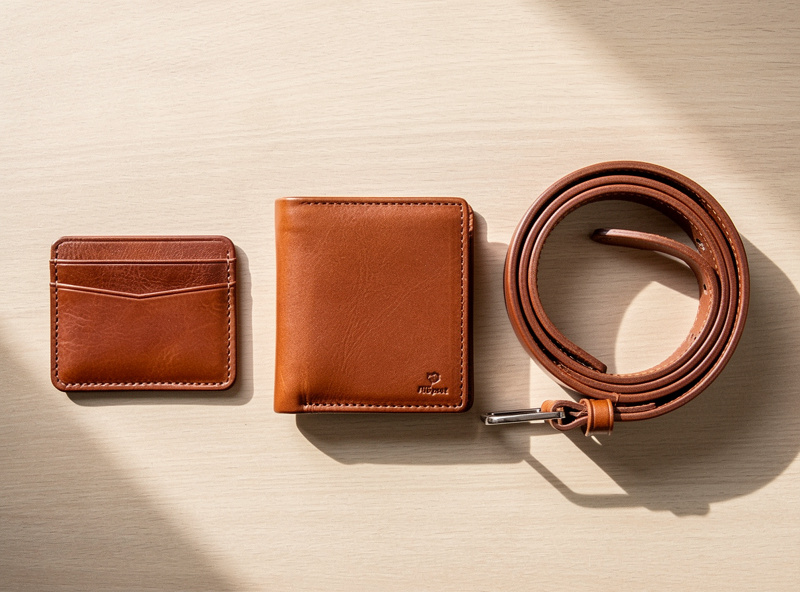
| Project | Typical Build Hours | Where Most Hours Go |
|---|---|---|
| Card holder (3-slot) | 1.5–2.5 hrs | Skiving seams, edge finish on multiple layers |
| Bifold wallet (interior pockets) | 4–8 hrs | Interior pocket stitching, edge finish on every panel |
| Belt (1.5 in, with buckle) | 2–4 hrs | Straightedge cutting, edge bevel over full length, hardware setting |
| Knife sheath (fixed blade, wet-formed) | 4–7 hrs | Wet-forming and drying time, welt stitching |
| Small bag or pouch | 6–10 hrs | Panel assembly, lining, hardware, edge finish on curved seams |
Interior pockets are the clearest example of hours that don’t show in a finished photo — a bifold with four to six card slots roughly doubles the stitching length of a two-slot design, and every one of those extra seams needs its own edge finish where it’s exposed. A buyer comparing two wallets that look similar from the front has no way to see that difference without asking or handling the piece.
Why Quality Costs Noticeably More Than Mass-Produced
Mass-produced leather goods are built on machines that cut, stitch, and even burnish edges in seconds per unit, using corrected-grain or bonded leather that’s cheaper per square foot and consistent enough for automated cutting. None of that is inherently dishonest — it’s just a completely different production model, optimized for speed and uniformity rather than character or longevity. The price gap between that and a hand-stitched veg-tan piece isn’t markup; it’s the difference between machine-minutes and skilled human hours, and between commodity hide and tannery-sourced leather that costs meaningfully more per square foot.
What that buys you in practice: a hand-stitched veg-tan piece that develops a patina instead of cracking, an edge that stays smooth instead of fraying, hardware that doesn’t flake, and a stitch line that survives decades of flexing instead of a lockstitch that unravels the first time a thread catches. Whether that’s worth the price difference to you depends on how long you want the piece to last and whether the patina and hand-finish matter to you — but it’s not a mystery where the money goes once you know what to check.
What To Look For When Evaluating a Piece
A short checklist, in the order I’d actually check them on a piece in hand: run a finger down the edge (smooth and rounded, or fuzzy and flat); check the back of the stitch line (identical front and back means saddle stitch; different front to back means machine); look at the hardware edges for a scratch or wear mark that reveals plating; ask what tannage and, if they’ll say, what tannery the leather came from; and check whether interior seams — the parts nobody photographs — got the same edge treatment as the parts that show. A maker who’s confident in the answer to all five is a maker who did the work.
Frequently Asked Questions
Why does handmade leather cost more than store-bought leather goods?
Handmade leather goods use tannery-sourced leather (often veg-tan) that costs more per square foot than corrected-grain commodity hide, and they take real skilled hours to hand-cut, hand-stitch with a saddle stitch, and hand-finish the edges. A bifold wallet alone can run four to eight hours of build time. Mass production replaces almost all of that labor with machine-minutes, which is the main source of the price gap.
What is the difference between veg-tan and chrome-tan leather?
Veg-tan (vegetable-tanned) leather is tanned slowly with plant tannins, holds tooling and stamping, takes a burnished edge, and develops a deep patina with handling and sun exposure. Chrome-tan is tanned quickly with chromium salts, stays soft and pliable, and suits bags and soft goods, but will not hold a burnished edge or patina the same way. Neither is universally better — the right one depends on the project.
How can I tell if a wallet is actually hand-stitched?
Check the back of the stitch line. A genuine saddle stitch (two needles, one thread) looks identical on both faces with a slight diagonal lean at each hole. A machine lockstitch looks different front to back — one face shows a straight running stitch, the other shows small locking loops.
Why does the edge finish matter so much on leather goods?
The edge finish — bevel, sand, slick, and wax or seal — is the step most often rushed on mass-produced or low-effort handmade goods. A properly finished edge looks turned rather than cut and feels smooth under a finger. A skipped edge stays flat, slightly fuzzy, and darkens unevenly with handling.
Does more expensive hardware actually matter on leather goods?
Yes. Solid brass or solid nickel-silver hardware does not rust or flake and stays the same color through a scratch. Plated hardware looks identical when new but reveals a different-colored base metal at any scuff, and can corrode at contact points within a year of regular pocket or bag use.
Why do bifold wallets with more card slots cost more?
Interior card slots roughly double the stitching length compared to a simple two-slot design, and every exposed seam needs its own edge finish. That labor does not show in a front-facing photo, which is why two similar-looking wallets can represent very different amounts of actual build time.
Related Guides
- How to Evaluate Handmade Leather Goods: A Buyer’s Guide
- Full-Grain vs Top-Grain Leather
- Types of Leather Cluster
- Leatherworking Tools Guide
- Leathercraft for Beginners Cluster